
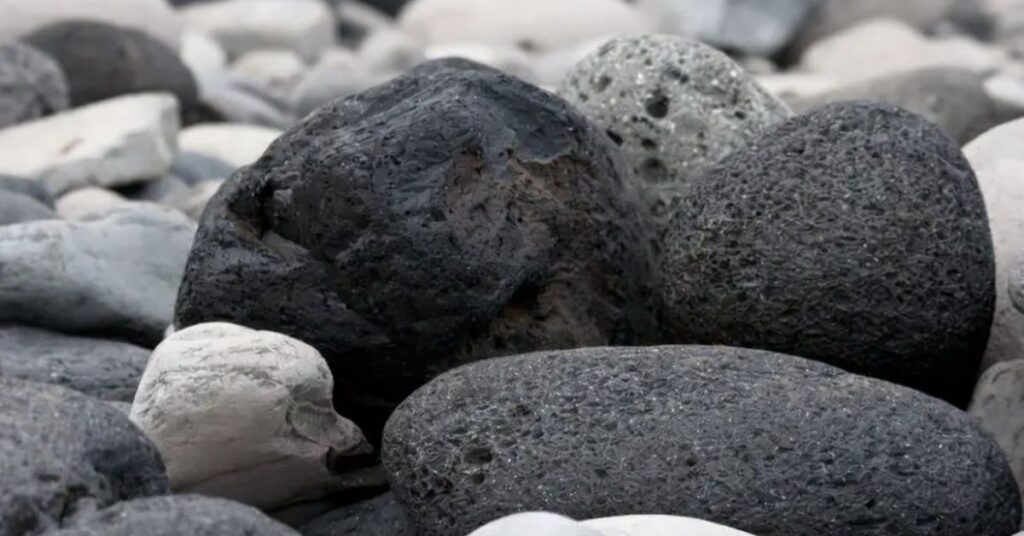
Iceland’s volcanic rocks,basalt, obsidian, rhyolite, tephra, and palagonite, are the visible record of millions of years of eruptions, rifts, and ice. Each one tells a different chapter. This guide helps you identify them in the field and understand what they reveal about the landscape you’re walking through.
Iceland Volcanic Rocks: The Black Stone
You pick up a rock in Iceland. It sits cold and heavy in your palm. Black, slightly porous, with sharp edges where it fractured. You have no idea how old it is. Ten thousand years, maybe. Or two hundred thousand. It was molten not so long ago, geologically speaking.
Most visitors walk past thousands of these stones without a second thought. But each one is a frozen moment: the exact second the lava stopped moving. The question is not what the rock is. The question is what it’s trying to tell you.
Why Iceland Volcanic Rocks Are Unique
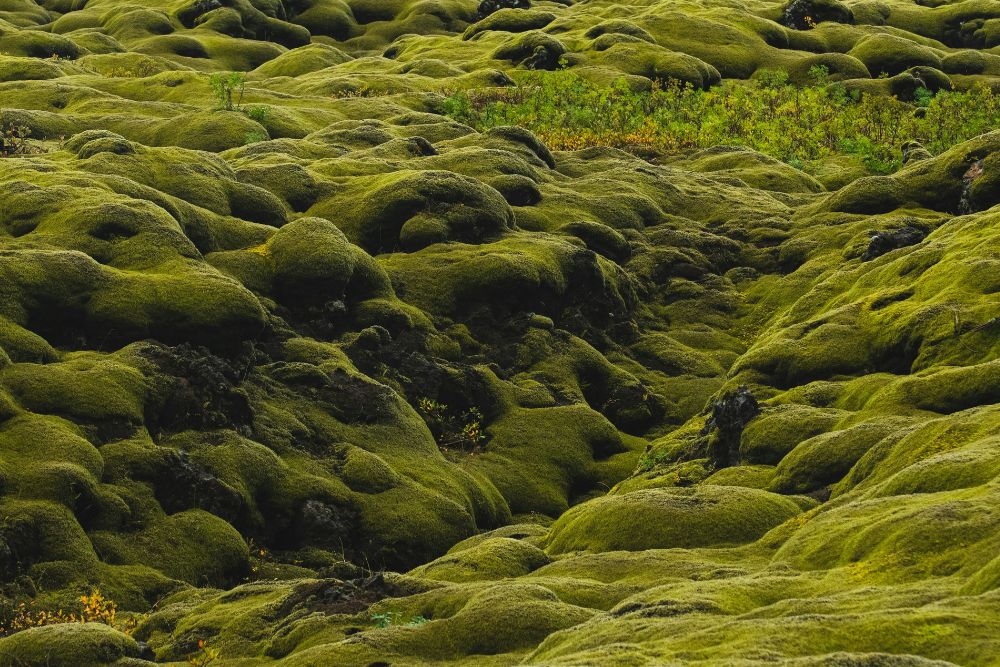
Most countries have varied geology: granite mountains, limestone cliffs, sandstone valleys. Iceland has almost none of that. It is built almost entirely from volcanic rock, layer after layer of eruptions stacked on top of each other over 16 million years.
This is because Iceland sits above a mantle plume, a column of superheated rock rising from deep in the Earth, while also straddling the Mid-Atlantic Ridge, where two tectonic plates are slowly pulling apart. That combination means Iceland is essentially being built from the inside out, one eruption at a time.
Learning to read those rocks is learning to read the island itself.
5 Iceland Volcanic Rocks You’ll See
You don’t need a geology degree to notice these. You just need to know what to look for.
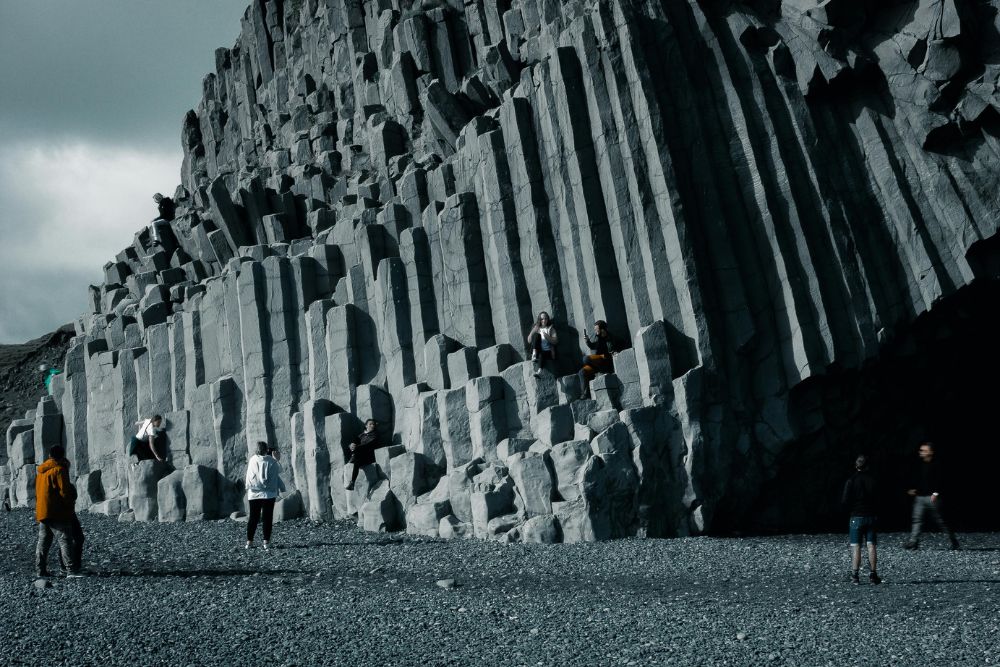
Basalt is the foundation of Iceland. Dark grey to black, dense, and fine-grained, it forms when lava cools quickly on the surface. Most of the lava fields you’ll walk across are basalt. Look for hexagonal columns, like the ones at Reynisfjara beach, where the rock contracted as it cooled, cracking into perfect geometric shapes. When you see those columns, you’re looking at a process that took years, not centuries.
Obsidian
Obsidian looks like black glass, because it is black glass. When silica-rich lava cools so fast that crystals never have time to form, the result is a natural volcanic glass sharp enough that surgeons still use obsidian blades for certain procedures. In Iceland, you’ll find it near rhyolitic vents. Handle it carefully. The edges are not decorative.
Tephra and Volcanic Ash
If basalt is the main story, tephra is the footnotes. Every eruption leaves a layer of ash, pumice, and rock fragments. Geologists read these layers like pages in a book, each band of grey or brown ash corresponds to a specific eruption at a specific date. The dark tephra layer from the 1783 Laki eruption, for example, is visible in ice cores as far away as Greenland. Iceland’s ground keeps its records.
Rhyolite
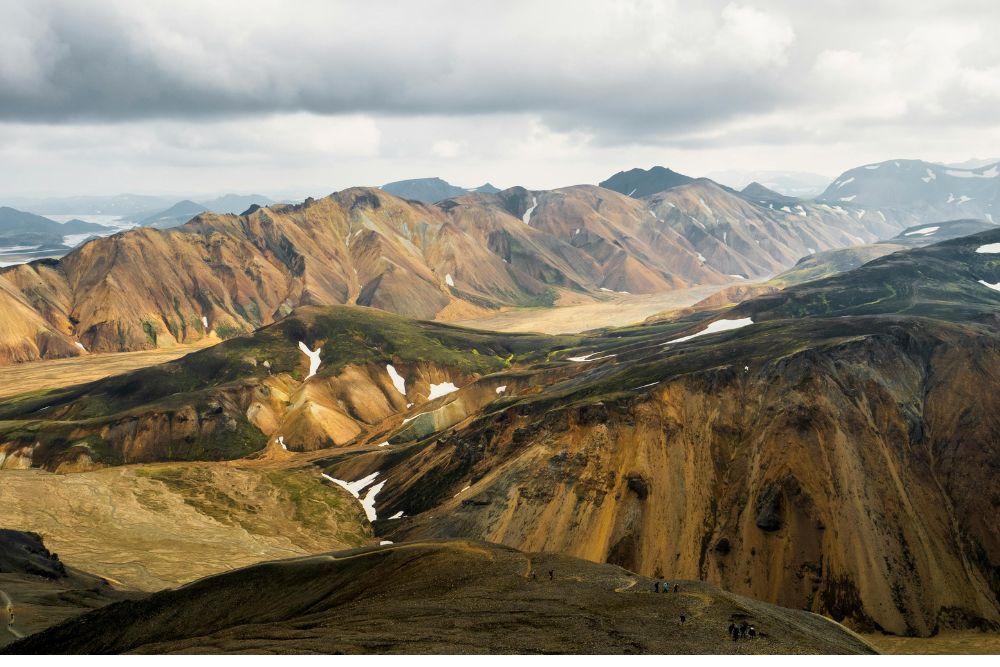
Not everything in Iceland is black. Near the Landmannalaugar highlands, the hills glow in shades of pink, yellow, and green. This is rhyolite: a light-coloured, silica-rich volcanic rock that forms when magma cools slowly underground before being exposed by erosion. The colours come from mineral impurities, iron oxides, sulfur deposits, hydrothermal alteration. Rhyolite is rarer than basalt in Iceland, which makes the places where it appears feel almost surreal.
Palagonite
The orange-yellow rock you’ll notice on many Icelandic hillsides is palagonite, what happens when basaltic lava erupts under water or ice. The rapid chilling shatters the lava into glassy fragments called hyaloclastite, which then slowly alters into palagonite through a chemical reaction with water. Many of Iceland’s distinctive table mountains, called tuyas, are built from this material. They are, essentially, the record of eruptions that happened beneath glaciers during the last ice age.
Iceland Volcanic Rocks: How to Look Without Taking
There is a rule in Iceland that most visitors don’t know until they’re at the airport: it is illegal to collect rocks, minerals, or fossils without a permit. The law exists because geological sites are irreplaceable. Every rock removed erases part of the record. Scientists working in Iceland rely on undisturbed sites to date eruptions, map lava flows, and understand how the island evolves.
More practically: loose rocks from famous sites often carry microscopic organisms. Moving them spreads non-native life across ecosystems that took thousands of years to stabilise.
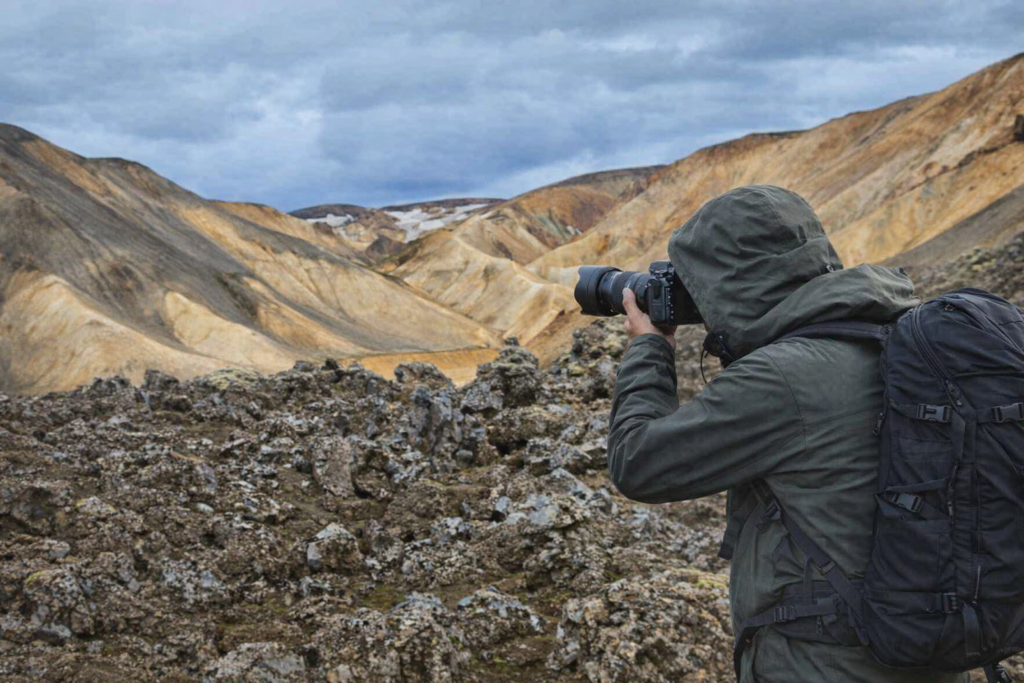
The alternative is simple. Put the rock back down. Take a photograph instead. The image will still be there in ten years. The formation won’t rebuild itself.
3 Questions for Iceland Volcanic Rocks
You don’t need equipment. You need a habit. Next time you stop at a lava field or volcanic outcrop, run through these three questions:
- Colour: Is it dark (basaltic, low silica, fluid lava) or light (rhyolitic, high silica, viscous lava)? Colour is the first clue to temperature and composition.
- Texture: Is it smooth, glassy, porous, or crystalline? Smooth and glassy means fast cooling. Coarse crystals mean slow cooling underground. Pores mean gas bubbles were trapped as the lava solidified.
- Context: Where exactly are you standing? Near a fissure vent, at the base of a volcano, on a coastal platform? The location tells you how the rock got there and what force shaped it.
Three questions. Thirty seconds. The rock goes from obstacle to evidence.
Every Rock Is a Sentence
The lava fields of Iceland are not empty. They are archives. Every basalt column, every obsidian shard, every orange slope of palagonite is a sentence in a text that was written before humans existed and will still be written long after we’re gone.
You don’t need to memorise chemical formulas to feel that. You just need to slow down long enough to pick up one stone and ask: where did you come from?
The next step is understanding the full library.
Read the complete story: Iceland’s Volcanoes: A Beginner’s Guide to Reading Earth’s Fire
Pingback: Iceland: When Did This Island Actually Form?
Pingback: Silfra Rift: Swiming Between Two Continent In Iceland
Pingback: Iceland Volcanoes Explained ; The Guide to Earth's Fire
Pingback: Iceland Highlands Geology: What the Colors Actually Mean