
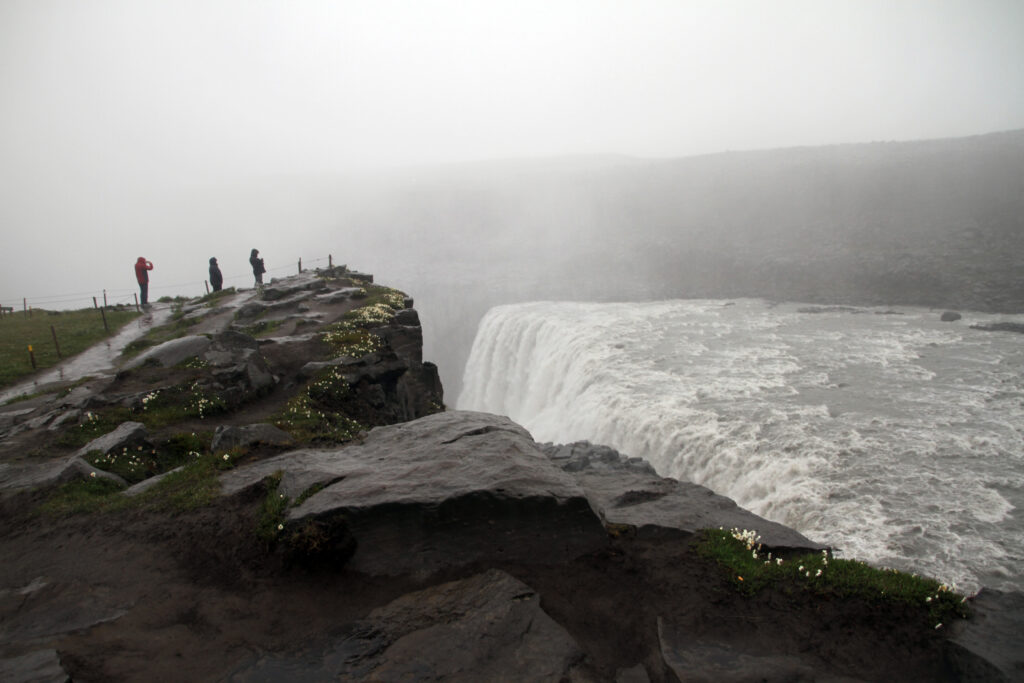
Dettifoss is a waterfall in northeastern Iceland with an average discharge of 193 cubic metres per second, making it the most powerful waterfall in Europe. It is fed by meltwater from the Vatnajokull glacier, carried 200 kilometres by the Jökulsá á Fjöllum river through a canyon carved by glacial floods over 10,000 years. Its power is geological, not accidental.
Before you see it, you feel it
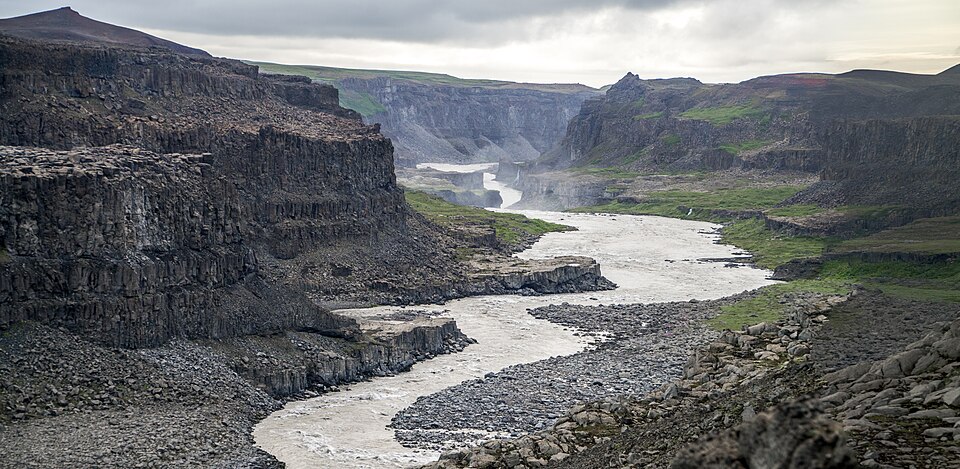
The path from the parking area to Dettifoss is about fifteen minutes on foot. For most of that walk, you see nothing. The land is flat, dark, volcanic. Then the ground begins to vibrate. Not violently. Subtly, through the soles of your boots. Then the sound arrives: a low, continuous roar that does not increase so much as it reveals itself, the way thunder does when you realise it never actually stopped.
Dettifoss does not perform for you. It does not wait for you to arrive. It has been falling at this rate for thousands of years, and it will continue long after the viewing platform is gone. What you experience when you reach the edge is not a spectacle. It is an interruption of scale.
The waterfall drops 44 metres into the Jökulsárgljúfur canyon. The spray rises high enough to create a permanent mist visible from a kilometre away. On a clear day, a rainbow forms in it. None of this is decoration. All of it is physics. To understand why this canyon exists at all, you need to follow the water back to where it started.
Where this water comes from
The Jökulsá á Fjöllum river begins under ice. Its source is Vatnajokull, Europe’s largest glacier, 200 kilometres to the south. As the glacier melts, surface water and subglacial runoff drain northward through a network of rivers and channels, gathering volume across Iceland’s interior highlands before converging into this single river.
By the time the Jökulsá á Fjöllum reaches Dettifoss, it drains a catchment area of roughly 7,900 square kilometres. Everything that melts across that vast basin eventually passes through this 100-metre-wide channel and drops over the same basalt edge.
The water is brown. This surprises most visitors who expect something blue or clear. The colour comes from glacial sediment: fine particles of pulverised rock carried from the glacier bed, suspended in the water. The brown is geological. It is the glacier grinding Iceland into powder and sending it north.
193 cubic metres per second is the average discharge. During spring melt, when Vatnajokull sheds the most water, the flow can reach 500 cubic metres per second. At that rate, Dettifoss moves more water than any other river in Europe, channelled into a single roaring curtain of brown and white.
How a canyon gets built in 10,000 years
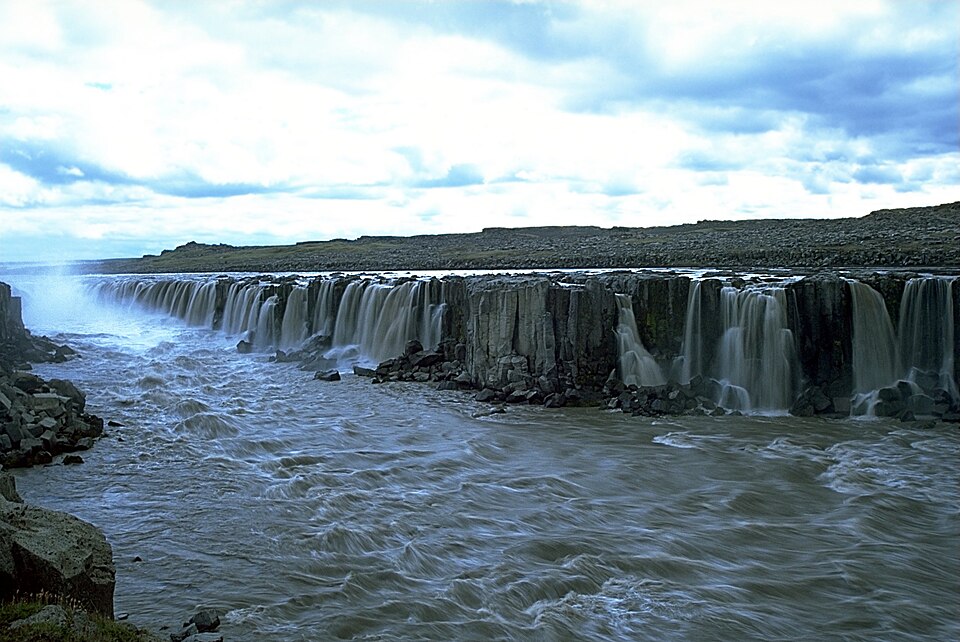
The canyon surrounding Dettifoss, Jökulsárgljúfur, did not exist before the last Ice Age. Ten thousand years ago, this land was under a sheet of ice that compressed the entire landscape beneath it. When the ice retreated, it did not go quietly.
Catastrophic glacial floods, called jökulhlaups, swept across Iceland’s interior with a force that reshaped everything they touched. Water released from subglacial lakes and ice dams carved through basalt rock at a rate that would take a normal river millions of years to achieve. The canyon of Jökulsárgljúfur, 25 kilometres long and up to 100 metres deep, was largely formed in episodes of violent flooding over a period of a few thousand years.
Basalt, the rock that forms the canyon walls, fractures in predictable ways. It splits into columns, into blocks, into angular fragments. Water exploits every joint and crack. What you see at Dettifoss is not just a waterfall. It is the leading edge of an erosion process. The same volcanic rock that built Iceland’s surface is being systematically dismantled here, block by block, and carried north to the sea.
Selfoss, a broader and shallower waterfall, lies one kilometre upstream. Hafragilsfoss lies one kilometre downstream. They are part of the same system, each one a different stage in the river’s negotiation with the basalt beneath it.
Two banks, two experiences
Dettifoss can be approached from two sides. The east bank and the west bank are connected by a road that requires crossing the entire northern part of Iceland, roughly two hours of driving. Most visitors choose one side. The choice matters, and it is geological as much as practical.
The west bank offers the closest view. You can stand within a few metres of the waterfall’s edge, close enough for the spray to reach you, close enough to feel the vibration in your chest rather than just your feet. The perspective is frontal and overwhelming. The scale of the water is most legible from here.
The east bank is further from the edge but higher above it. From here, you see the full width of the canyon, the river approaching from the south, and the relationship between Dettifoss and the landscape around it. You understand where the water comes from and where it goes. The view is less dramatic but more complete.
Geologically, both banks are the same basalt. The difference is the angle of understanding. The west bank shows you the force. The east bank shows you the system. A thorough visitor with time should see both.
What dettifoss is still building
Dettifoss is not finished. The waterfall is actively retreating upstream. As the plunge pool erodes the basalt at the base of the falls, the edge moves south at a rate of roughly a few centimetres per year. In 10,000 years, it will be positioned noticeably further upstream. The canyon will be longer, deeper, and wider.
This is how canyons work. The Grand Canyon retreats. Niagara Falls retreats. Every waterfall that falls on erodible rock is simultaneously destroying the thing that makes it possible, moving backward through the landscape at a pace invisible to a single human lifetime.
At Dettifoss, the basalt columns you see in the canyon walls were part of the riverbed not long ago in geological terms. The ones visible at the edge today will be in the canyon floor within a few thousand years. The ones still underground will eventually become walls.
What you are looking at, standing at the edge of the canyon, is not a fixed point in Iceland’s landscape. It is a moving boundary between what the river has already taken and what it has not yet reached. The full geological story of Iceland’s north runs through this canyon, from the ice that feeds it to the sea that receives it.
The lesson the canyon teaches
Most waterfalls are beautiful. Dettifoss is legible. It shows you, in real time, what water does when it has enough volume, enough gravity, and enough time. It shows you a glacier turning into a river turning into a canyon turning into a coastline.
The brown water is not a disappointment. It is the point. It is Iceland being remade, slowly and continuously, by the same forces that made it.
Forty kilometres to the west, Lake Myvatn was born from a volcanic eruption 2,300 years ago. The two places, read together, show the same landscape from opposite directions: one built by fire, one carved by water. Iceland does not choose between its forces. It uses all of them, all at once.
Frequently asked questions
Is Dettifoss the most powerful waterfall in Europe?
Yes. Dettifoss has an average discharge of 193 cubic metres per second, the highest of any waterfall in Europe. During spring melt, the flow can reach 500 cubic metres per second. The power comes from its source: the continuous melt of the Vatnajokull glacier, 200 kilometres to the south.
Which side of Dettifoss is better, east or west?
The west bank is closer to the falls and more viscerally powerful. The east bank is higher and offers a broader view of the canyon and the river system. If you have time, both are worth visiting. If you can only choose one, the west bank gives you the more immediate experience.
Can you swim near Dettifoss?
No. The current upstream and downstream of the falls is extremely dangerous, and swimming is prohibited in the area. The discharge volume and the unpredictable nature of glacial melt pulses make the river lethal at any point near the waterfall.
What this place teaches
What this place teaches
Dettifoss shows that water, the softest force in nature, builds canyons, moves mountains, and reshapes continents. Given enough time and volume, nothing is permanent, not even basalt.
For young explorers
Find Dettifoss on Google Earth. Look upstream along the Jökulsá á Fjöllum river and find where it begins at Vatnajokull. Can you trace the entire path the water travels before it falls? Measure the distance in kilometres.
The Deep Time angle
The Jökulsárgljúfur canyon is 10,000 years old. The Grand Canyon took 5 to 6 million years to form. Dettifoss and its glacial floods carved a comparable depth in 0.2% of that time. This is what happens when a glacier releases its water all at once.
Further reading
Book: The Beak of the Finch by Jonathan Weiner (on the pace of natural change). App: Veðurstofa Íslands for real-time river levels. Scientific reference: Baynes et al., 2015, Flood-driven canyon formation, PNAS.