
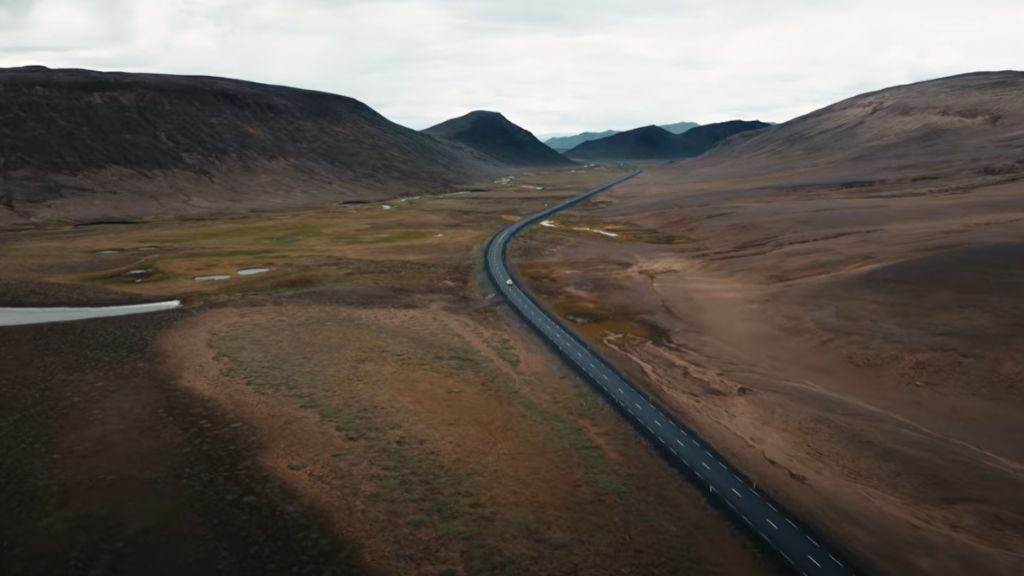
Look at a map of Iceland and most people see a road trip. One ring road, clockwise or counter-clockwise, a week or two, waterfalls and geysers and northern lights. That is one way to read it. There is another way.
Iceland is one of the few places on Earth where the geology is not buried under millions of years of erosion, sediment and time. The Mid-Atlantic Ridge runs directly through the island. Volcanoes erupt every few years. Glaciers sit on top of active magma chambers. The landscape you drive through is not the result of geology. It is geology, still in progress, visible from a car window.
The iceland geology road trip is not about becoming a geologist. It is about learning to read a landscape that has been writing its own story for 20 million years. This guide is a starting point for that kind of travel.
Iceland’s Five Geological Worlds
Iceland looks like a single island. Geologically, it is five distinct worlds, each shaped by a different combination of forces. Knowing which world you are driving through changes what you notice.
Zone 1 — The Reykjanes Peninsula
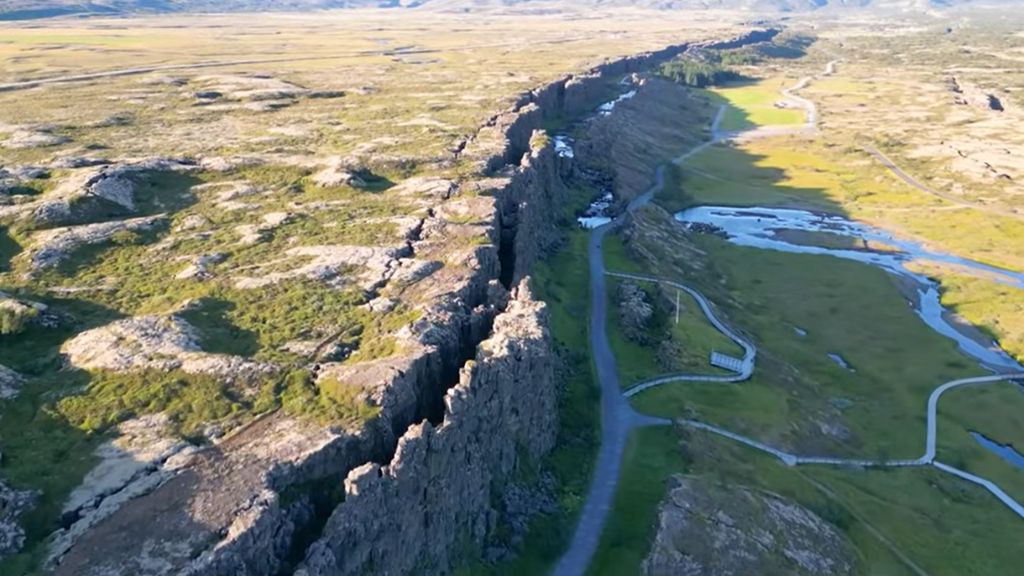
The southwest corner of Iceland is where the Mid-Atlantic Ridge meets the surface. This is one of the only places on Earth where a mid-ocean ridge rises above sea level. The landscape is raw: fractured basalt, sulphurous vents, lava fields that are younger than many European cities. The 2023 eruptions near Grindavik brought fresh lava to the surface less than two years ago.
Zone 2 — The Central Highlands
Iceland’s interior is one of the least visited landscapes in Europe, and one of the most geologically extreme. Rhyolite mountains in shades of red, orange and yellow. Vast volcanic deserts. Calderas large enough to contain small towns. The highlands are what Iceland looks like when erosion has not yet softened the edges.
Zone 3 — The South and the Glaciers
Vatnajökull dominates the south, a glacier the size of a small country sitting above several active volcanoes. The black sand plains between the glacier and the coast are formed from volcanic material carried by glacial floods called jökulhlaups. This is Iceland’s youngest landscape, constantly rearranged by water and ice.
Zone 4 — The Basaltic North
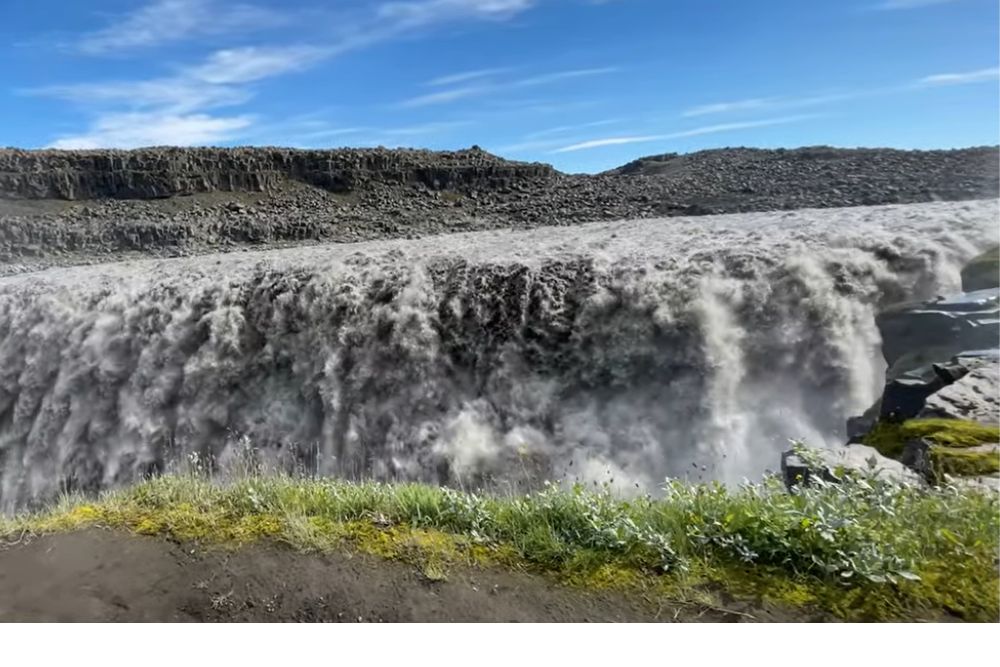
The north of Iceland is shaped by basalt. Dettifoss cuts through a canyon made entirely of columnar basalt. Lake Mývatn sits in a volcanic field still geothermally active. The lava formations at Dimmuborgir look like a landscape from another planet. This is Iceland at its most ancient and most legible.
Zone 5 — The Westfjords
The oldest rocks in Iceland are here, around 16 million years old. The Westfjords are shaped by erosion rather than volcanism, their deep fjords carved by glaciers over millions of years. Driving through the Westfjords is driving backward in geological time.
| Reading the Map: Iceland’s geology follows a rough east-west pattern. The youngest rocks are in the centre, where the rift is active. The oldest rocks are on the coasts, where lava has had more time to erode. If a landscape looks soft and rounded, it is old. If it looks sharp and fractured, it is recent. |
A 10-Day Itinerary for Reading Iceland’s Geological Story
This itinerary follows, the iceland geology road trip, the Ring Road with geological logic as its organising principle. Each day adds a layer to the story.
Days 1–2: Reykjavik and the Reykjanes Peninsula
Begin at the edge of the Mid-Atlantic Ridge. The Reykjanes Peninsula is the most tectonically active part of Iceland right now. Walk the rift valley at Reykjanesviti, where the gap between the North American and Eurasian plates is visible at the surface. Visit the Silfra fissure at Þingvellir, where glacial water fills the crack between two continents.
Geological lesson: the boundary between two tectonic plates is not always underwater and invisible. Here, you can stand on it.
Day 3: South Coast — Basalt, Black Sand, Waterfalls
Drive east along the south coast. The waterfalls at Seljalandsfoss and Skógafoss fall over basalt cliffs formed by ancient lava flows. The black sand beaches are volcanic material ground down by centuries of wave action. Every colour in this landscape comes from the same source: basalt.
Days 4–5: Vatnajökull and Jökulsárlón
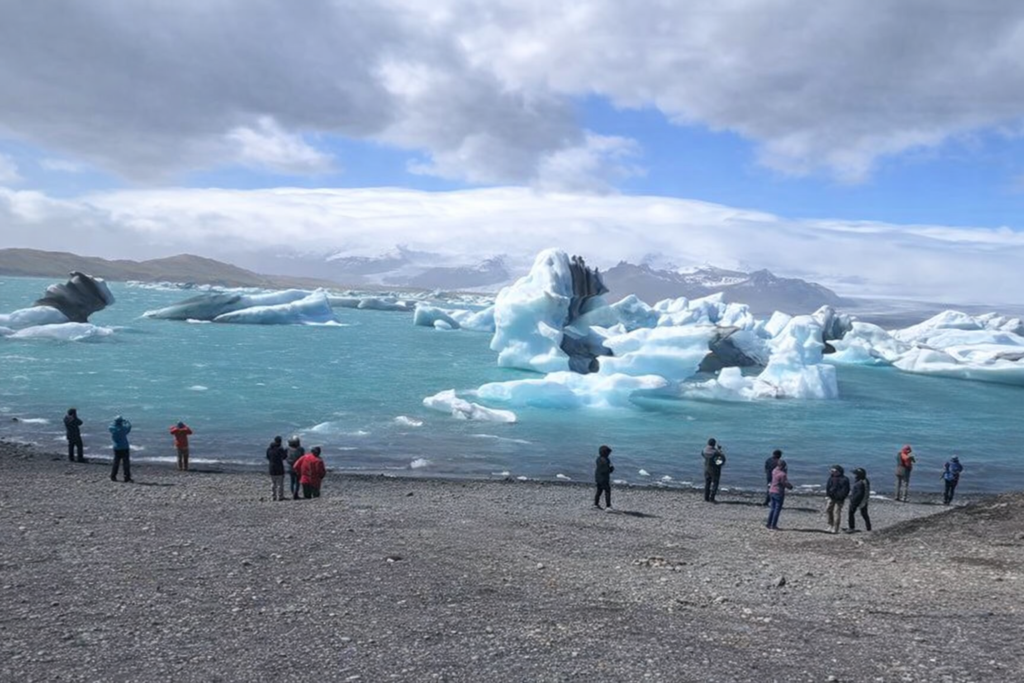
Europe’s largest glacier sits above multiple active volcanoes. When those volcanoes erupt under the ice, the resulting floods can carry more water than the Amazon. Jökulsárlón, the glacial lagoon a few kilometres from the glacier’s edge, did not exist a century ago. It formed as the glacier retreated and has been growing since. The icebergs floating in it fell as snow hundreds of years ago.
For the full story of this place, the article on Vatnajökull: what happens when a glacier sits on top of a volcano covers the dynamics in detail.
Day 6: The Transition North
The drive from the south to the north crosses Iceland’s geological spine. The landscape changes visibly every fifty kilometres. Lava fields give way to river plains, river plains to highland desert, highland desert to the basalt formations of the north. This is the itinerary’s clearest lesson in geological zones.
Day 7: Dettifoss and Jökulsárgljúfur Canyon
Dettifoss carries more water over its edge than any other waterfall in Europe. The canyon beneath it was carved in roughly 10,000 years by glacial floods after the last Ice Age. On geological timescales, that is not long. The article on Dettifoss: the waterfall that moves explains how that canyon came to be.
Day 8: Lake Mývatn
Mývatn was created 2,300 years ago when a lava flow dammed a river. The pseudo-craters on its shores were formed not by volcanic vents but by steam explosions when lava flowed over wet ground. The geothermal field around the lake is still active. This is one of the few places in the world where you can watch a lake and a volcanic system evolving at the same time.
Day 9: Akureyri to Snaefellsnes
The drive west crosses the north of Iceland, where basalt dominates and the landscape is shaped more by erosion than by recent volcanism. Akureyri sits at the head of Iceland’s longest fjord, carved by a glacier that retreated around 10,000 years ago.
Day 10: Snaefellsnes Peninsula
The peninsula ends at Snæfellsjökull, a stratovolcano capped by a glacier. Jules Verne chose this place as the entrance to the centre of the Earth in his 1864 novel. The geological reasoning was sounder than it might seem. The peninsula is a cross-section of Iceland’s volcanic history, from ancient lava flows to the glacier-capped summit that may lose its ice cap within decades.
The full geological story is in the article on Snaefellsnes: Jules Verne was right about this place.
What Every Geotraveler Needs Before the Trip
The right tools do not turn you into a geologist. They slow you down in the right places.
Apps
The Icelandic Meteorological Office app (Veðurstofa) tracks volcanic and seismic activity in real time. According to en.vedur.is, Iceland averages one volcanic eruption every four to five years, with significant seismic activity between eruptions. Knowing where the activity is changes how you plan each day’s drive.
GeoloGPS is a field geology app with topographic and geological map overlays. It shows rock formations, fault lines and volcanic zones layered over your GPS position. On a road trip, it answers the question you will ask dozens of times: what am I actually looking at right now?
Books
A field guide to Icelandic rocks is worth packing before you leave. The ability to identify basalt, rhyolite, obsidian and tuff in the field changes the road trip from observation to understanding. A guide to Iceland’s geology gives you the context for what the field guide identifies.
For a complete equipment and reading list, a dedicated geotraveler’s packing guide for Iceland is coming soon.
Equipment
Waterproof boots are not optional in Iceland. Neither is a 10x hand lens, which reveals the crystal structure of volcanic rock invisible to the naked eye. A field notebook is more useful than most travellers expect. Writing one observation per stop produces, by the end of the Ring Road, a personal geological record of the island.
The Geotraveler’s Code
Iceland’s geology is accessible in a way that almost no other destination on Earth can match. That accessibility depends on the landscape remaining intact.
Iceland’s moss is among the slowest-growing vegetation on the planet. A footprint on a moss field can take decades to disappear. Stay on marked paths, particularly on lava fields and moss-covered terrain.
Taking rocks, sand or volcanic material out of Iceland is illegal. It is also, in a real sense, taking the landscape away from future visitors. The geological interest of Iceland’s beaches and lava fields comes from their condition, not their components.
Photograph rather than collect. A well-composed photograph of a basalt column or an obsidian formation records more geological information than a specimen in a bag, and leaves the place unchanged.
The comparison between Iceland and Hawaii — two volcanic islands built by different geological mechanisms — is worth understanding before you visit. The article on Iceland vs. Hawaii: two volcanic islands, two very different stories makes that contrast concrete.
A Road That Is Still Being Built
A road trip in Iceland can be many things. It can be photographs of waterfalls and thermal pools. It can be a checklist of famous stops. It can also be something harder to plan and easier to remember: a week or two of paying attention to a landscape that is genuinely unlike anywhere else on Earth.
Iceland is not a geological museum. The ridge is still pulling apart. The volcanoes are not dormant. The glaciers are moving, and some of them are retreating faster than at any point in recorded history. Whatever you come to see, you are seeing it at a specific moment in a story that started 20 million years ago and has no visible end.
That is worth slowing down for.
FAQ
How many days do you need to see Iceland’s geology properly?
Ten days is the minimum for the Ring Road with geological stops. Fewer days means skipping zones, and each zone tells a different part of the story. Two weeks allows time to go slower at the sites that deserve it, particularly Þingvellir, Vatnajökull and Mývatn.
What is the best time of year for a geology road trip in Iceland?
June to September offers the most accessible conditions. Summer keeps the highland roads open and the glacier excursions running. The geology is visible year-round, but winter road conditions close sections of the Ring Road and many interior tracks. April and May are underrated, with lower visitor numbers and dramatic light.
Do I need a 4WD for Iceland’s geological sites?
The Ring Road does not require 4WD in summer. The highland routes, including access to Askja and several central volcano systems, do. If the Central Highlands are part of your itinerary, a 4WD rental is not optional.
What are the most unique geological features only found in Iceland?
The combination of a mid-ocean ridge above sea level, active subglacial volcanism, and geologically recent (last 10,000 years) landscape formation makes Iceland genuinely singular. Jökulhlaups, the subglacial flood events triggered by volcanic eruptions under ice, occur nowhere else on Earth with the same frequency or scale.