
iceland geysers explained : You are standing in a field of steam. The ground around you is warm, faintly sulphurous, and looks completely still. A small depression in the rock holds a pool of blue water, perfectly calm. You have been waiting four minutes.
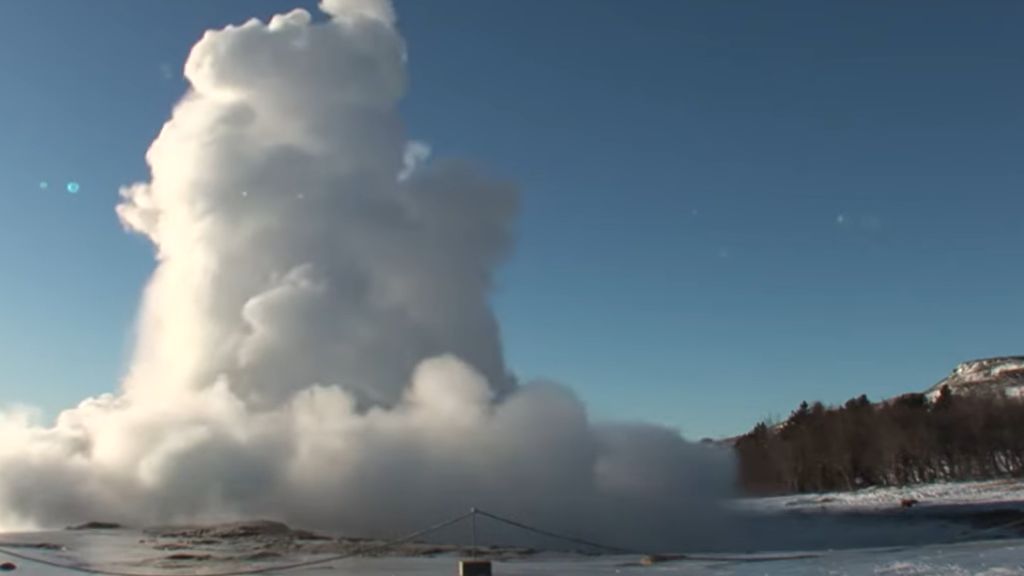
Then the surface shivers. A dome of water rises, collapses, rises again. A sound like something mechanical releases beneath your feet. And then the column shoots up, fifteen metres into the cold air, before gravity pulls it back down and the pool goes quiet again.
Iceland’s geysers explained in one sentence: they are pressure valves. The Earth builds up heat, water absorbs it, and when the physics tips past a certain threshold, everything releases at once. Understanding why how this happens changes what you see when you stand there waiting.
The Word That Gave Geysers Their Name
The word geyser is Icelandic. It comes from Geysir, a hot spring in the Haukadalur valley that European travelers were writing about as early as the 13th century. The name itself derives from the old Norse gjósa, meaning to gush. When geologists eventually found similar features elsewhere in the world, in Yellowstone, in New Zealand, in Kamchatka, they borrowed the Icelandic word. Iceland named the phenomenon for the rest of the planet.
The great Geysir, the original, is now mostly dormant. It erupted reliably for centuries, sending columns of water as high as 80 metres before a series of earthquakes and decades of human interference disrupted its plumbing. Visitors in the 19th century discovered that dumping soap into the vent would trigger an eruption on demand. They did this repeatedly. The residue accumulated. Geysir never fully recovered.
Strokkur, a few metres away, took over the role. It erupts every five to ten minutes, reliably and without prompting, and has become one of the most watched geological events in Iceland. Most visitors to the Golden Circle see Strokkur and assume they are seeing Geysir. They are not. They are seeing what Geysir used to be.
Three Things That Have to Line Up
iceland geysers explained: Geysers are rare. Of the roughly one thousand known in the world, more than half are in Yellowstone. Iceland has around forty active ones. Most hot spring systems never become geysers because the conditions require a very specific combination that rarely occurs in the same place at the same time.
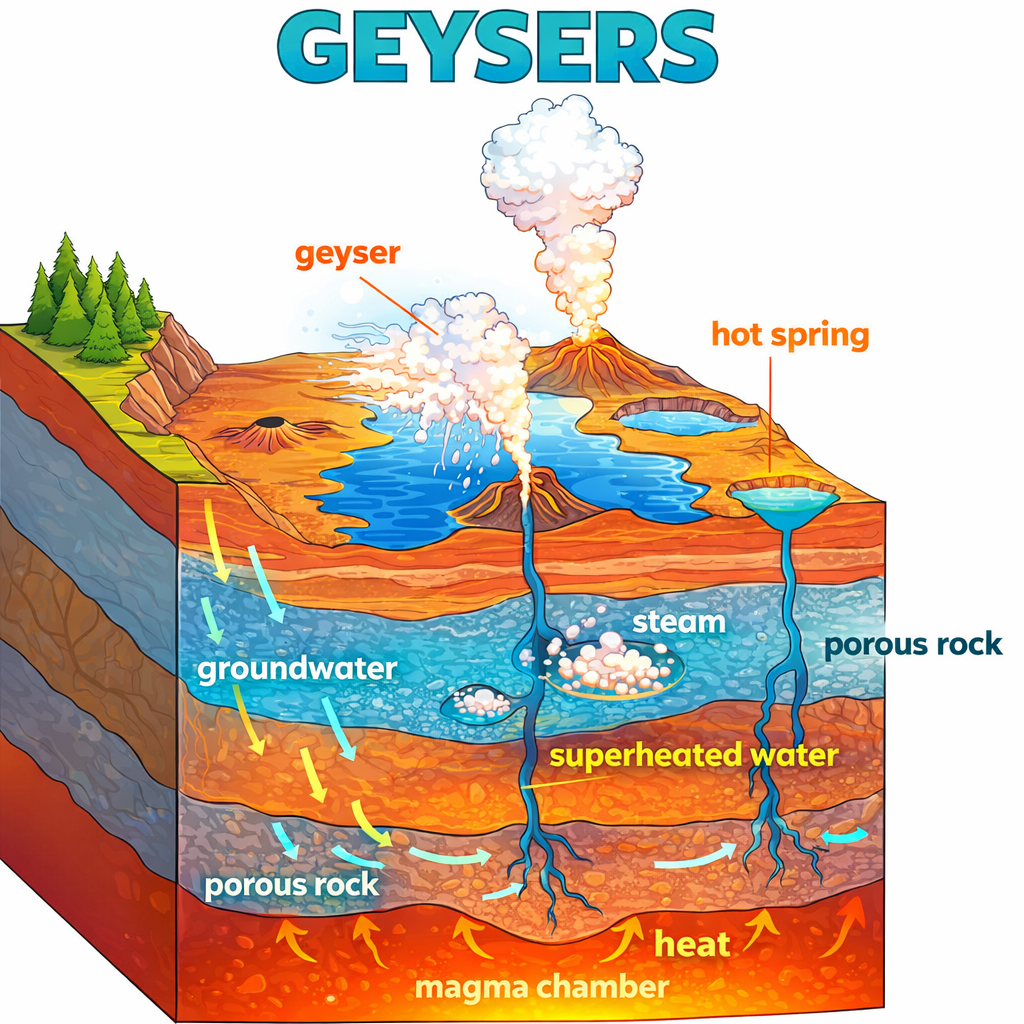
The first requirement is water. Rainwater and snowmelt seep down through porous volcanic rock, sometimes traveling for decades before reaching the heat source below. The water feeding Strokkur likely fell as rain or snow somewhere on the plateau above, filtered through lava for years, and is only now completing its circuit.
The second requirement is heat. Iceland’s geothermal activity is driven by the same forces that produce its volcanoes: the Mid-Atlantic Ridge and the mantle hotspot beneath the island. At depth, rock temperatures are high enough to superheat water far beyond its normal boiling point. For more on how that heat moves through Iceland’s geology, the article on
what happened at Reykjanes covers the underlying mechanics of Iceland’s volcanic systems in detail.
The third requirement is the one most people overlook: the right plumbing. The conduit connecting the underground chamber to the surface has to be narrow enough to maintain pressure, and shaped in a way that prevents the water from boiling prematurely. If the pipe is too wide, the heat dissipates and you get a hot spring. If it curves at the wrong angle, convection keeps the water circulating and it never builds to a critical state. A geyser requires a very specific architecture underground, and that architecture has to stay intact.
The Nordic Volcanological Center at the University of Iceland documents how Iceland’s geothermal fields behave over time, including the relationship between seismic events and changes in geyser activity. Earthquakes, it turns out, can both kill a geyser and create one, depending on how they rearrange the rock below.
Why Strokkur Erupts Every Five Minutes
The regularity of Strokkur is not magic. It is geometry. The chamber beneath it refills at a predictable rate, and the conduit above it reaches a critical pressure at a predictable point in that cycle. Once the eruption clears the pipe and the water drains back, the clock resets.
Old Faithful in Yellowstone takes roughly 90 minutes between eruptions, because its chamber is larger and takes longer to recharge. Pohutu in New Zealand erupts multiple times per hour, but its cycle is less consistent because its plumbing is more complex and influenced by neighboring vents. Each geyser has its own rhythm because each one has a different underground system. The regularity you observe is the signature of a specific geological structure, not a property of geysers in general.
What this means is that when Strokkur’s timing changes, something underground has changed with it. Seismologists pay attention to geyser intervals for exactly this reason. A geyser that suddenly erupts more or less frequently is telling you something about pressure, temperature, or structural changes in the rock below. It is, in a real sense, a natural instrument.
How a Geyser Dies
The great Geysir is the clearest example of what happens when the architecture breaks down. By the early 20th century, the practice of triggering eruptions with soap had left residues in the conduit. Earthquakes in 1896 and 2000 temporarily reactivated it, but its natural rhythm never returned at full strength. What the soap started, time and seismicity completed.
This is not a story about carelessness in isolation. It is a story about cumulative effect. A single handful of soap thrown by a single visitor in 1900 changed almost nothing. A thousand handfuls, thrown by visitors over decades, changed the system permanently. The conduit is not self-cleaning. What goes in tends to stay.
The same logic applies to the area around any active geyser. The soil crust at Strokkur and the surrounding Haukadalur field is fragile and slow to recover, for the same reasons that Iceland’s moss takes centuries to regenerate after disturbance. The roped perimeters around active vents exist because the ground just outside them is often undercut by hot water moving through cavities below the surface. The risk is not only to the geyser. It is to the person standing too close.
A geyser is a summary of everything Iceland does in miniature: heat from below, water from above, rock controlling the outcome. The same forces that built the island, that split it along the Mid-Atlantic Ridge and pushed magma through its crust for 20 million years, are the forces that fill Strokkur’s chamber every five minutes and push it skyward.
The full story of how those forces work together across Iceland is covered in our guide to Iceland’s geological formation and deep time. And for those who want to understand what the ground between the geysers is actually made of, the guide to Iceland’s volcanic rocks covers every rock type you will encounter on the walk from the parking area to the vent.
[Placeholder: link to Iceland’s Volcanoes: A Beginner’s Guide to Reading Earth’s Fire — article not yet published]
Frequently Asked Questions
How do geysers work?
A geyser forms when groundwater seeps into an underground chamber near a heat source and is superheated beyond its normal boiling point. Pressure builds because the narrow conduit above prevents the water from boiling freely. When the pressure exceeds a critical threshold, the water flashes to steam and the column erupts. After the chamber empties, the cycle begins again.
Why does Strokkur erupt so regularly?
Strokkur’s regularity comes from the geometry of its underground system. The chamber refills at a consistent rate, and the conduit reaches critical pressure at a predictable point in that cycle. Larger geysers like Old Faithful in Yellowstone take longer between eruptions because their chambers are bigger. Each geyser’s interval is a signature of its specific underground structure.
Can you throw things into a geyser?
No, and the consequences can be permanent. Objects thrown into a geyser accumulate in the conduit, disrupting the pressure dynamics and water circulation that make eruptions possible. The original Geysir in Iceland is largely dormant today partly as a result of soap and debris thrown in by visitors over more than a century. The damage is irreversible. The roped perimeters around active vents are there to protect both the geyser and visitors, as the ground around active vents is often undercut by subsurface hot water.
What This Place Teaches
| The Geological LessonA geyser is not a performance. It is a clock. The interval between eruptions is determined by underground geometry, recharge rate, and pressure thresholds that have nothing to do with the audience watching from the rope line. |
For Young Explorers
Time Strokkur between eruptions. Write down the interval for five consecutive eruptions. Are they exactly the same, or do they vary? What might cause the variation? This is the same method geologists use to monitor changes in a geyser’s underground system.
The Deep Time Angle
The water currently in Strokkur’s chamber fell as rain or snow somewhere above the Haukadalur valley, then spent between 30 and 100 years filtering through porous lava before reaching the heat source below. The eruption you are watching is the end of a journey that began before most people watching it were born.
Further Reading
The Nordic Volcanological Center at the University of Iceland publishes ongoing research on Iceland’s geothermal systems, including how seismic activity affects geyser behavior. It is the primary academic reference for anyone who wants to go deeper into the geology of the Haukadalur field and Iceland’s geothermal systems more broadly.