
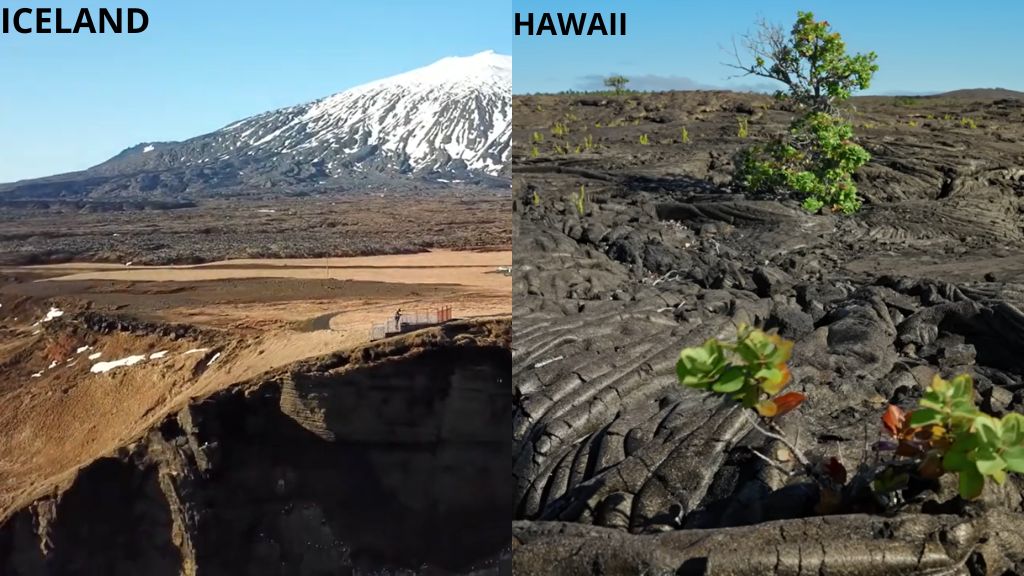
Iceland vs. Hawaii geology: Hawaii and Iceland are both volcanic islands built from basalt. But they formed through entirely different mechanisms, look nothing alike, and are heading in opposite geological directions. One sits above a fixed hotspot in the middle of the Pacific. The other straddles the most active tectonic boundary on the planet. Understanding the difference changes how you read both.
If You Loved Hawaii, There Is a Geological Reason
Most people who visit Hawaii do not think of themselves as geology enthusiasts. But the thing that draws them, the lava flows, the black sand beaches, the sense that the ground beneath their feet is not finished yet, is geology. They are responding to a planet in the act of making itself.
Iceland produces the same response, and for related reasons. Both islands are volcanic. Both are young by geological standards. Both have black sand and active eruptions and landscapes that feel raw in a way that older, more settled places do not.
The difference is in the engine. Hawaii is powered by a single fixed hotspot beneath the Pacific Plate. Iceland is powered by two forces at once: that same kind of deep mantle plume, and the Mid-Atlantic Ridge, where two tectonic plates are slowly pulling apart. The result is a different kind of island, built differently, shaped differently, and moving through geological time in a different direction.
Two Mechanisms, One Planet
Beneath Hawaii, a column of superheated rock rises from deep in the Earth’s mantle. The Pacific Plate moves slowly northwest over it, at roughly 7 to 9 centimeters per year. As the plate moves, the hotspot punches through it in a new place, creating a new island. This is why the Hawaiian archipelago forms a chain: each island is older than the one to its southeast, dragged away from the source by the moving plate. Kauai is the oldest of the main islands, around 5 million years old. The Big Island is the youngest, still directly over the hotspot, still growing.
Iceland works differently. The island sits on top of the Mid-Atlantic Ridge, a 16,000-kilometer underwater mountain range where the North American and Eurasian plates are pulling apart. That spreading creates space, and magma fills it from below. Iceland is the only place on Earth where this ridge rises above sea level. A deep mantle hotspot sits beneath it as well, which is why Iceland produces more volcanic material than the spreading alone would explain. The combination of two forces in the same place is what makes Iceland geologically extreme.
The USGS Volcano Hazards Program documents both hotspot systems in detail, with comparative data on eruption frequency and magma composition across Pacific and Atlantic volcanic chains. https://www.usgs.gov/programs/VHP
Why The Landscapes Look So Different
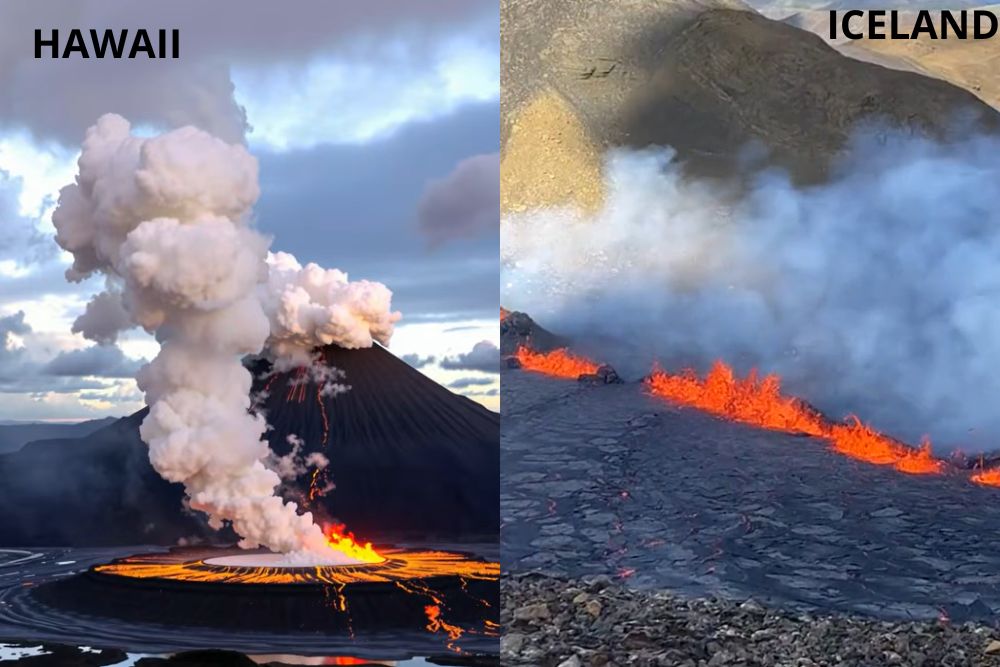
Iceland vs. Hawaii geology: islands are built primarily from basalt, the same dark, dense, iron-rich rock. But the landscapes they produce look nothing alike, and the reason is age, climate, and the way the volcanic activity is distributed.
Hawaii’s Big Island has active lava flowing into the ocean on its southeastern shore, but most of the island is green. Rainfall is high on the windward slopes, and the volcanic soil, once it weathers, is extraordinarily fertile. Vegetation moves in quickly on older flows. The landscape transitions from bare black lava near active vents to dense forest within a few kilometers.
Iceland is younger in some areas and older in others, but the climate keeps vegetation slow. Moss takes centuries to colonize a lava field. The interior is largely bare, a high desert of ash and ancient ice. The color palette runs from black to grey to white, interrupted by the rust and green of geothermal areas. The rawness is not just geological. It is climatic.
There is also the matter of the eruptions. Hawaiian eruptions are typically effusive, producing rivers of lava that flow slowly enough to allow evacuation. Iceland has effusive eruptions too, but also explosive ones, particularly when magma meets ice or water. The 2010 Eyjafjallajokull eruption produced an ash cloud that grounded European air traffic for six days. That kind of eruption is rare in Hawaii.
The Geological Future of Each Island
Hawaii and Iceland are both moving through time, but in opposite directions.
The Big Island of Hawaii is currently over the hotspot, which is why it is the most volcanically active island in the chain. As the Pacific Plate continues moving northwest, the Big Island will eventually be dragged away from the hotspot, just as Maui and Kauai were before it. A new seamount, Loihi, is already forming on the seafloor southeast of the Big Island. In tens of thousands of years, it will become Hawaii’s next island.
Iceland, on the other hand, is not moving away from its source. The Mid-Atlantic Ridge is not going anywhere. The island will continue to grow as long as the plates keep spreading and the hotspot keeps producing magma. Iceland is, in geological terms, a work in progress with no near-term end date.
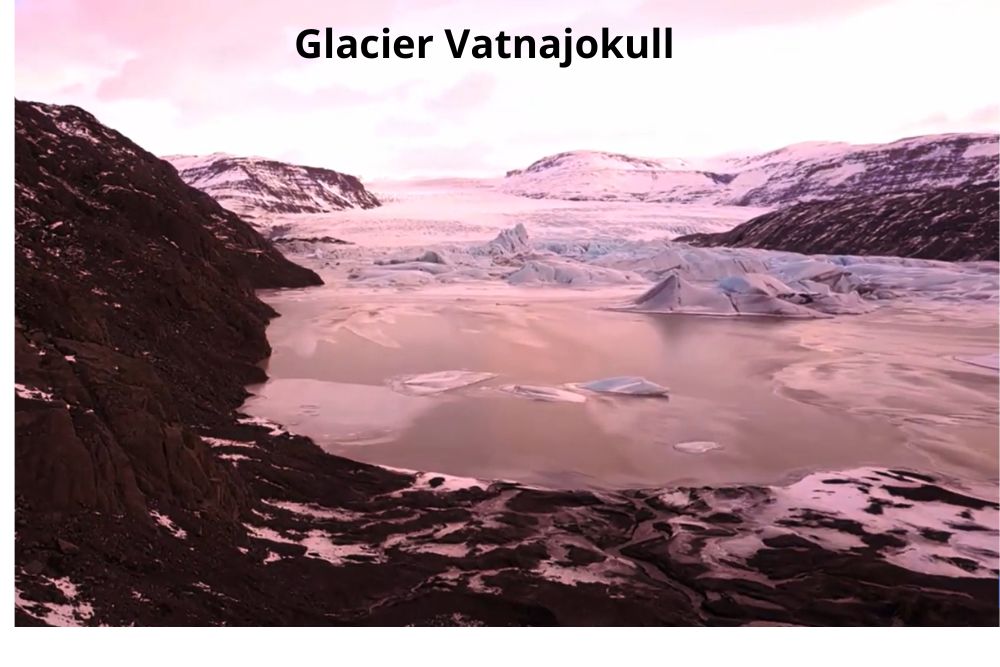
There is one significant consideration for Iceland’s current landscape, though not its geological future. Vatnajokull, Europe’s largest glacier, has been losing roughly one cubic kilometer of ice per year. As the ice retreats, the pressure it exerts on the volcanic systems beneath it decreases. Some volcanologists expect Iceland’s volcanic activity to increase over the coming centuries, a process called isostatic rebound. The article on Vatnajokull covers this relationship in detail. https://geonatra.com/vatnajokull-glacier-volcano-iceland-3/
Iceland vs. Hawaii: a Geological Comparison
| Iceland | Hawaii (Big Island) | |
| Surface area | 103,000 km2 | 16,600 km2 |
| Geological age | ~16 million years | ~5 million years |
| Volcanic mechanism | Mid-Atlantic Ridge + hotspot | Fixed hotspot |
| Eruption style | Fissure, effusive, explosive | Effusive (shield) |
| Lava temperature | ~1,100-1,200 C | ~1,000-1,170 C |
| Plate movement | Spreading (2.5 cm/year) | Pacific Plate moves NW |
| Vegetation on lava | Centuries (moss first) | Decades (tropical rain) |
What Each Island Teaches
Hawaii shows you what a volcanic island looks like when it has had time to settle. The raw lava is still there, near the active vents, but the older parts of the island have softened into something livable. You see the full arc: from bare rock to forest, from eruption to ecosystem.
Iceland shows you the earlier part of that arc. Much of the landscape is still in the raw phase. The moss is just beginning its work. The lava fields are recent. The fissures are still widening. Iceland does not ask you to imagine what the Earth looked like in formation. It shows you.
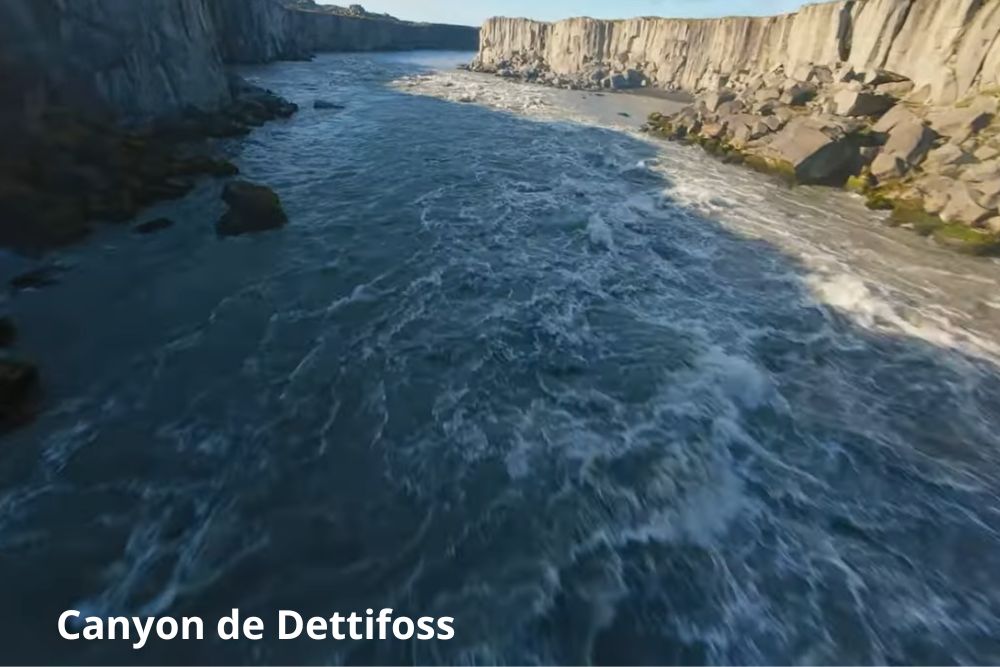
The canyon at Dettifoss was carved in roughly 10,000 years by glacial floods. On geological timescales, that is not long. On a human timescale, it is incomprehensible. Iceland makes that gap concrete. https://geonatra.com/dettifoss-waterfall-iceland-geology/
Frequently asked questions
Is Iceland or Hawaii more volcanically active?
Both are active, but in different ways. Hawaii’s Big Island has near-continuous lava activity, particularly from Kilauea. Iceland has more intermittent but often more dramatic eruptions, including large fissure eruptions and explosive events when magma interacts with ice or water. Iceland’s volcanic systems are monitored closely by the Icelandic Meteorological Office, which publishes real-time data at vedur.is.
Are Iceland and Hawaii made of the same rock?
Both are composed primarily of basalt, the most common volcanic rock on Earth. The chemical composition is similar because both form from magma that originates in the mantle. The differences in landscape come from age, climate, and the distribution of volcanic activity, not from the rock type itself.
Can you visit active lava in both Iceland and Hawaii?
Yes, but the experience differs. In Hawaii, lava flows at Kilauea are often accessible via guided tours on the Big Island. In Iceland, active lava viewing depends on the current eruptive phase. The Reykjanes Peninsula has seen repeated eruptions since 2021, with viewing areas opened and closed depending on safety conditions. Always check local authorities before visiting active volcanic areas.
The Same Rock, a Different Conversation
Hawaii shows you lava. Iceland shows you how an island is built. Both are the same process, the mantle producing basalt, the surface recording it, time organizing the result. What makes them feel so different is where each one sits in that timeline.
If Iceland is next on your list, starting with its geology is not a detour. It is the fastest way to understand what you are looking at. The Snaefellsnes peninsula, where Jules Verne sent his characters underground, is a good place to begin. https://geonatra.com/snaefellsnes-peninsula-geology-jules-verne-iceland