
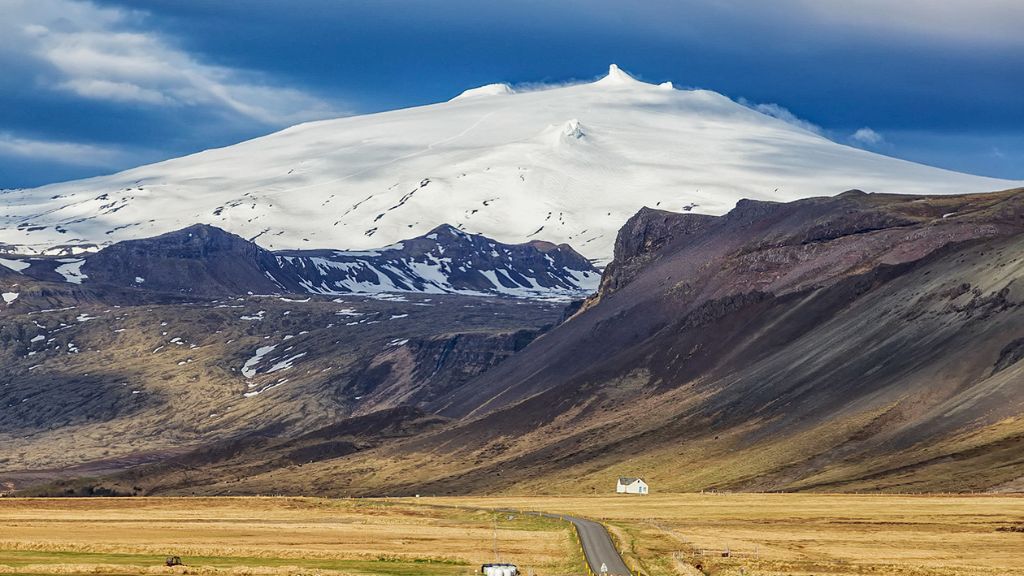
Snaefellsnes is a 90-kilometre peninsula in western Iceland, dominated by the Snaefellsjokull volcano and its glacier. It sits on its own geological system, separate from Iceland’s main volcanic zones, which makes it unusual. Jules Verne chose it as the entry point to the centre of the Earth. The science almost justifies that choice.
The novelist who read the landscape correctly
In 1864, Jules Verne sent his fictional explorers into the Earth through the crater of Snaefellsjokull. Most readers assumed it was a romantic invention, a dramatic backdrop chosen for atmosphere. It was not purely invented.
Verne had studied accounts of Iceland carefully. He understood, at least intuitively, that Snaefellsjokull was unlike other mountains. It is a stratovolcano capped by a glacier, sitting at the western tip of a peninsula that juts into the North Atlantic like a pointing finger. There is something visually and geologically extreme about it: the mountain is visible from Reykjavik on clear days, across more than 100 kilometres of water. It dominates everything around it.
Verne was not wrong to find it compelling. Geologists have been equally drawn to it, for different reasons.
A peninsula on its own geological terms
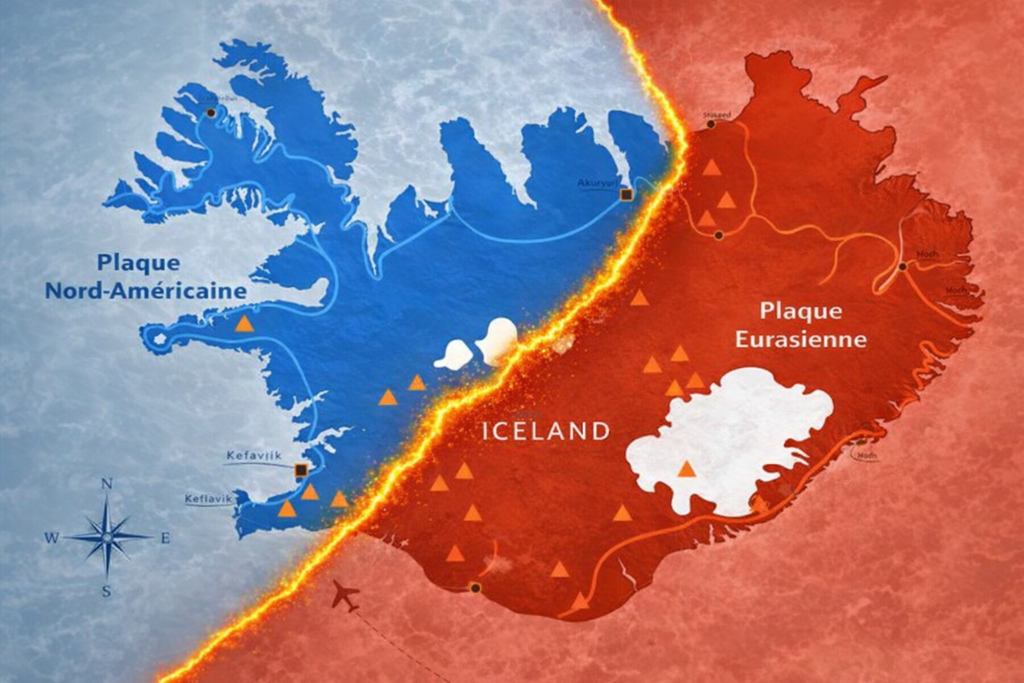
Iceland’s volcanic activity is concentrated along two main zones running roughly north to south through the island. Iceland’s main volcanic zones are driven by the Mid-Atlantic Ridge, where the North American and Eurasian plates are slowly pulling apart. Snaefellsnes is not part of that system.
The peninsula sits on what geologists call the Snaefellsnes Volcanic Belt, an older and separate system that runs east to west, perpendicular to the main volcanic zones. This oblique fault line is the reason the peninsula exists at all: volcanic activity along this belt built the land mass that extends into the sea.
This geological independence is what gives Snaefellsnes its particular character. The rocks here are older than those being produced along the active rift zones. The landscape feels settled, layered, worn in ways that the younger volcanic fields of the south and north do not.
Snaefellsjokull: The volcano under the ice
Snaefellsjokull is classified as a stratovolcano, built up through repeated eruptions of alternating lava and ash over thousands of years. Its last confirmed eruption was approximately 1,900 years ago, though some evidence suggests activity as recently as 200 years ago. It is considered dormant, not extinct.
The glacier that covers its summit adds a layer of complexity. A glacier sitting on a volcano is not simply decorative. If the volcano were to become active again, the interaction between rising magma and glacial ice would produce explosive phreatomagmatic eruptions, where water flash-converts to steam and amplifies the blast dramatically. Iceland has seen this process before. Eyjafjallajokull in 2010 demonstrated exactly how much disruption a glacier-capped eruption can cause.
For now, Snaefellsjokull’s glacier is retreating. Satellite images from the past three decades show a measurable reduction in ice cover. The volcano remains quiet. But the combination of ice and fire in a single mountain is not a stable equilibrium, it is a pause.
What the coastline reveals
The coastline of Snaefellsnes is one of the most geologically readable in Iceland. Walking it is effectively a lesson in volcanic processes.
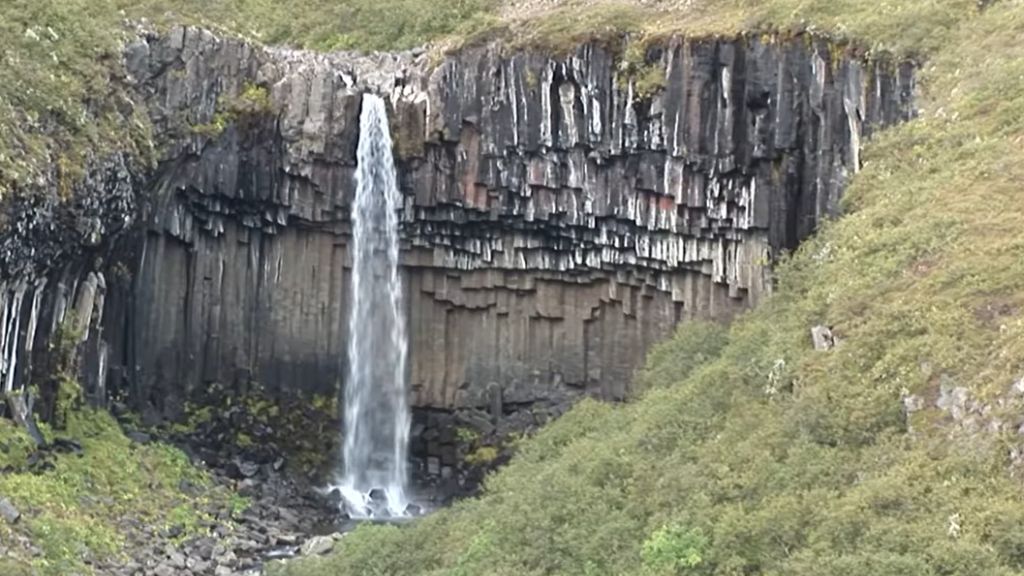
At Arnarstapi, basalt columns emerge directly from the sea cliffs. These hexagonal formations are the signature of basaltic lava that cooled slowly and evenly, contracting into geometric shapes as it solidified. The precision of the pattern, repeated across thousands of columns, reflects the physics of thermal contraction rather than any biological process.
The sea stacks at Londrangar are remnants of a volcanic plug: the hardened core of an ancient crater that resisted erosion long after the surrounding rock was worn away by waves. They stand isolated in the water, 75 metres high, as a record of what was once solid ground.
The black sand beaches in between are composed of basalt ground down by centuries of wave action. Every grain on those beaches was once part of a lava flow. The peninsula recycles its own geology continuously.
The geological lesson this place teaches
The lesson Snaefellsnes offers is precise: geology can nourish the imagination as much as science.
Verne did not have access to plate tectonics theory when he wrote Journey to the Centre of the Earth. Yet he chose a real anomaly, a volcano that sits outside its expected context, at the edge of a landmass pointing into open ocean, capped in ice that should not logically coexist with fire beneath.
The science, when it eventually caught up, confirmed his instinct. Snaefellsnes is genuinely unusual. That is not a coincidence. It is what good observation looks like before the vocabulary exists to describe it.
What this place teaches
A dormant volcano under a retreating glacier is not a contradiction. It is a system waiting for its next instruction from the Earth.
For young explorers
Pick up a piece of basalt on the beach and a piece of glacier ice (if accessible). Hold one in each hand. These two materials, rock and ice, are what Snaefellsjokull is made of. Ask yourself: what happens when the hot rock beneath the ice wakes up? Draw the result.
The deep time angle
he basalt columns you see on the coast took between 10,000 and 100,000 years to form through slow erosion. The volcano beneath the glacier last erupted roughly 1,900 years ago. The glacier itself began forming during the last ice age, approximately 2,500 years ago. Three timescales, all visible from the same viewpoint.
Further reading
Book: Journey to the Centre of the Earth, Jules Verne (1864) — read chapter 1 at the destination itself. App: Iceland Geology Map (App Store / Google Play) , identifies rock types in real time. Science: Icelandic Institute of Natural History, nat.is for field guides and geological maps.
An Edge That Explains the Island
Snaefellsnes is not Iceland’s most dramatic destination. It does not have the largest glacier or the most active volcano. What it has is clarity: a peninsula built on its own terms, following its own geological logic, where the relationship between fire, ice, and time is visible in a single view.
Jules Verne chose well. The centre of the Earth may be fiction. But the idea that this particular mountain contains something essential, something that explains how the planet works, that part holds.
To understand how all of Iceland’s geological places connect, read the full guide:
Iceland’s most geologically significant places: A Thoughtful Guide for Curious Travelers