
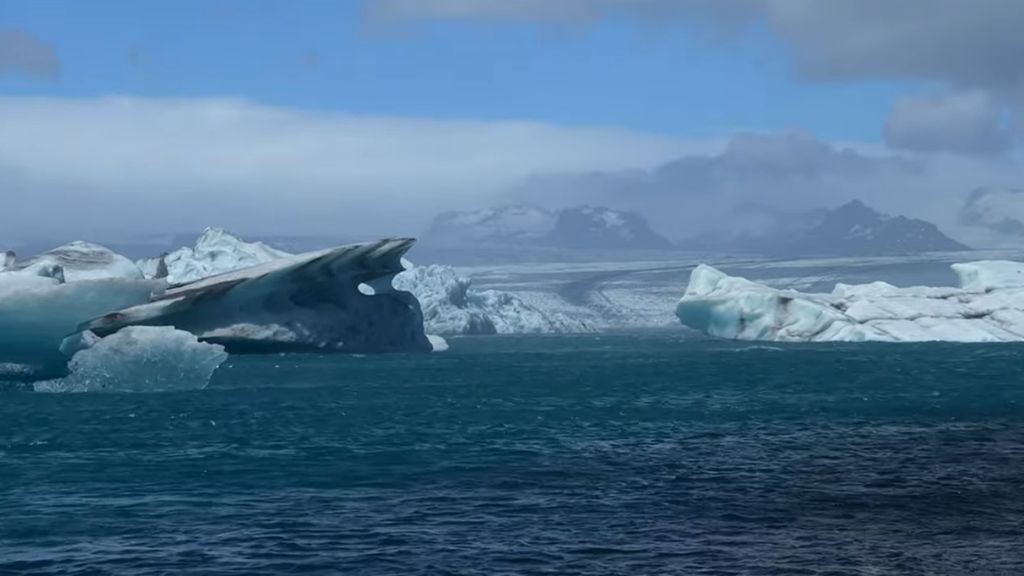
Picture yourself walking on ice. Beneath your crampons, a surface of pale blue stretches in every direction, silent and still. The air has that particular cold that empties the mind. And then the thought arrives, quiet but insistent: somewhere below, not far enough below, rock is melting.
This is not a thought experiment. This is Vatnajokull, and it is one of the strangest geological situations on Earth. Europe’s largest glacier sits directly above a cluster of active volcanoes. Fire and ice are not metaphors here. They are neighbours, separated by several hundred metres of compressed snow and time.
Understanding why changes the way you look at the landscape entirely.
A continent of ice
Vatnajokull covers roughly 7,900 square kilometres, about eight percent of Iceland’s total surface. For American visitors, a useful comparison: the glacier is larger than the state of Delaware. Its ice reaches up to 900 metres thick in places, pressing down on the land beneath with a weight that shapes geology in ways that will matter long after the ice is gone.
Beneath this mass of ice, eight distinct volcanic systems are currently active. Among them are Grimsvotn, one of Iceland’s most frequently erupting volcanoes, and Bardarbunga, whose 2014 eruption was the largest in Iceland in over 200 years. The glacier does not sit above dormant ground. It sits above some of the most geologically restless terrain on the planet.
Iceland itself exists because of two geological forces working in the same place at once: the Mid-Atlantic Ridge, where the Eurasian and North American tectonic plates pull apart, and a deep mantle hotspot that pushes exceptional volumes of magma toward the surface. Vatnajokull sits at the intersection of both. The ground beneath it is not just volcanic; it is among the most tectonically active areas in the Northern Hemisphere.
Fire under the ice: How it works
When a volcano beneath a glacier becomes active, it does not immediately explode through the ice. The heat rises gradually, melting the ice from below. Water accumulates in subglacial lakes, trapped under hundreds of metres of glacier, invisible from the surface, growing under pressure.
For a time, the system holds. Then it does not.
This dynamic connects directly to what you can observe at other sites across Iceland’s volcanic landscape. The river that carved the canyon at Dettifoss, for instance, draws from the same interconnected system of glacial meltwater and volcanic geology. Understanding Vatnajokull helps explain why Iceland looks the way it does from one end to the other.
For more on how Iceland’s geology shapes its most dramatic landscapes, see: Dettifoss: Why Europe’s Most Powerful Waterfall Exists Here and Nowhere Else.
Jokulhlaups: When the ice breaks
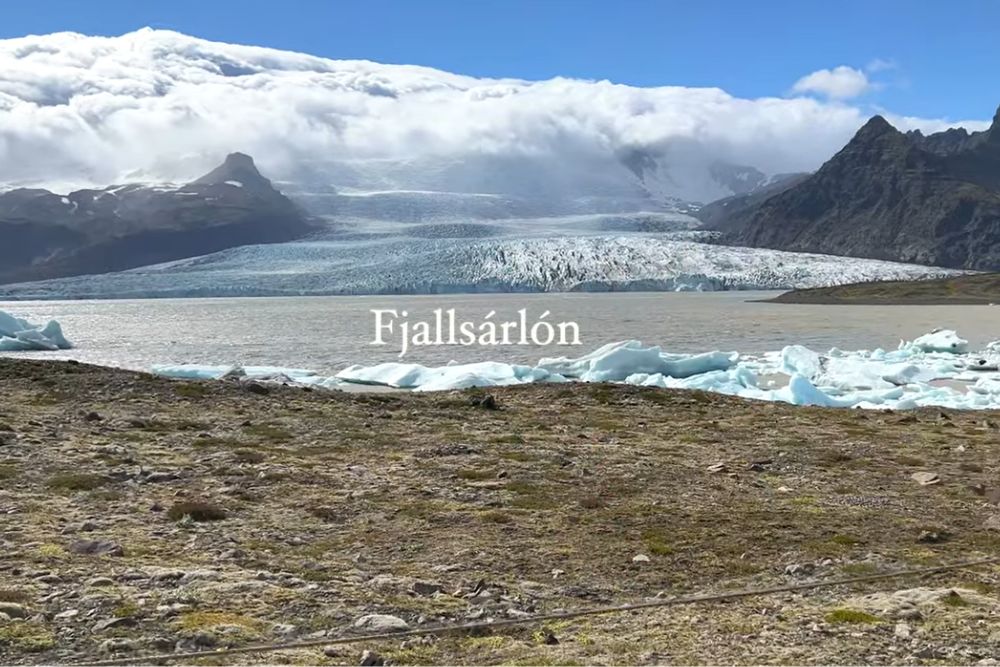
The word jokulhlaup comes from Icelandic and describes a glacial outburst flood, one of the most powerful hydrological events on Earth. When the subglacial lake beneath a volcano reaches a critical pressure, the water escapes suddenly, carving its way under the glacier and erupting at the margins with extraordinary force.
During the 2011 eruption of Grimsvotn, meltwater flooded out from beneath Vatnajokull and caused significant disruption across Iceland’s southern plains. But Grimsvotn has erupted more than 60 times in recorded history. The 1996 jokulhlaup that followed the Gjalp subglacial eruption briefly produced a water discharge estimated to exceed that of the Amazon River at peak flow. This lasted only a few hours. The bridge over the Skeidara river was destroyed in minutes.
Jokulhlaups are not rare anomalies. They are a recurring feature of life in southern Iceland. The flat, sandy plains stretching toward the coast south of Vatnajokull, the Skeidararsandur, were shaped almost entirely by repeated events of this kind over thousands of years. What looks like an empty, featureless desert is in fact a geological archive of catastrophic floods.
Jokulsarlon and Diamond Beach: What you actually See
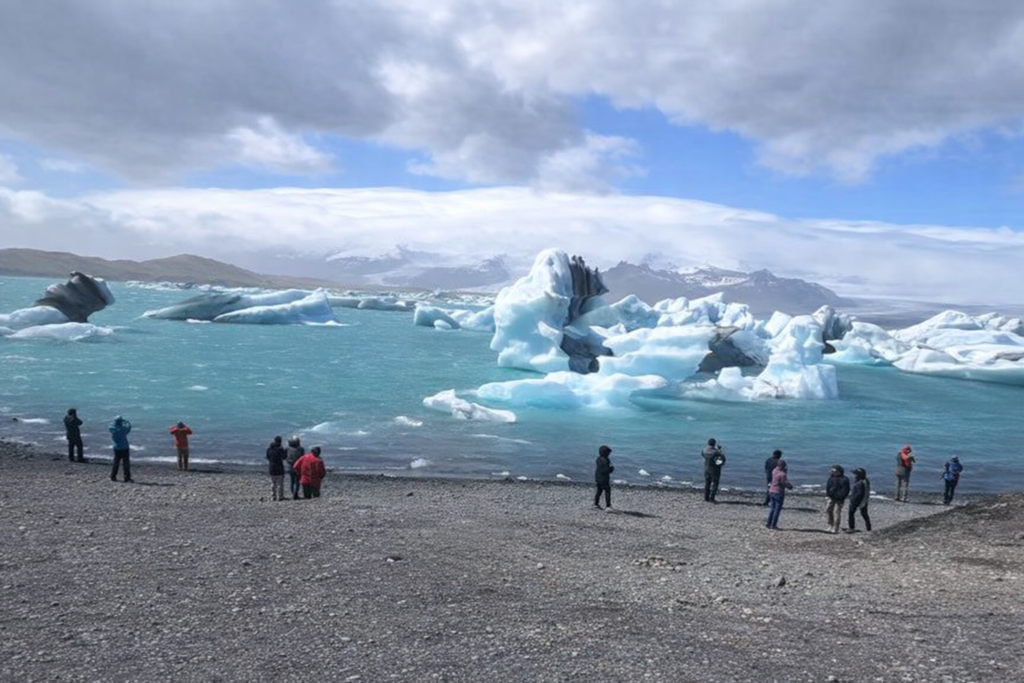
For most visitors, the closest encounter with Vatnajokull comes not on the glacier itself but at its edge. Jokulsarlon is a glacial lagoon formed where the Breidamerkurjokull outlet glacier meets the sea. Icebergs calve from the glacier’s face, drift slowly through the lagoon, and eventually reach the Atlantic.
What makes Jokulsarlon visually distinctive is the colour of some of those icebergs. Streaks of deep black run through the blue-white ice. These are bands of volcanic ash, layers of basalt and tephra deposited by past eruptions and trapped inside the glacier as it advanced over volcanic terrain thousands of years ago. The glacier moved forward, incorporated the ash, compressed it into dark ribbons, and is now releasing it into the lagoon as it retreats.
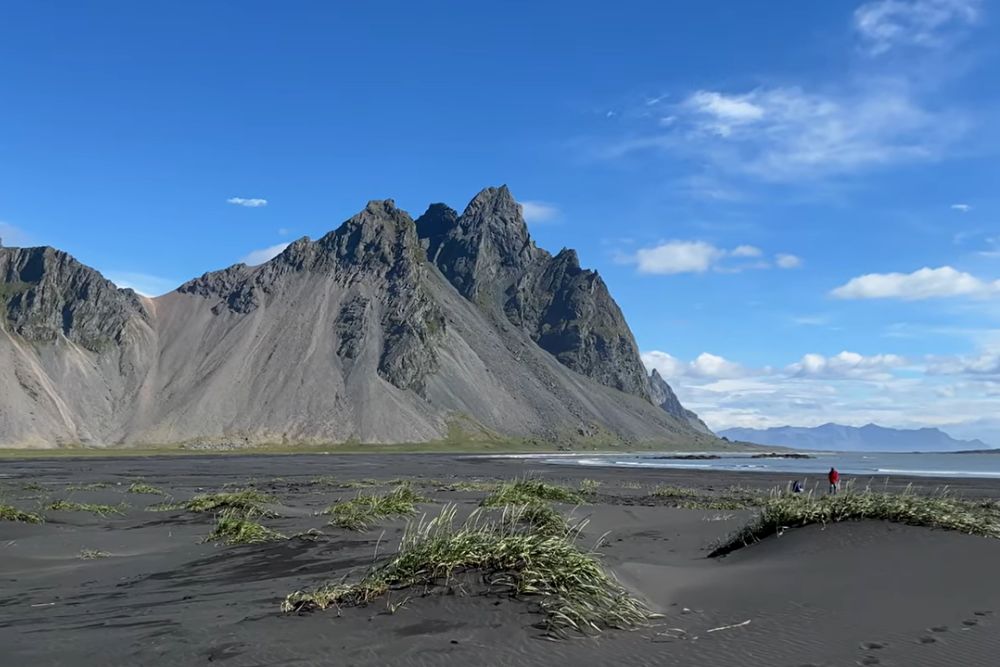
A short walk away, Diamond Beach is where these icebergs wash ashore and melt on black volcanic sand. The contrast is extraordinary: translucent ice resting on black basalt, both created by the same geological system, just separated by a few thousand years and a change of state.
It is one of those places where the geology becomes visible without any need for explanation. The landscape is already telling the story.
A glacier on a timer
Vatnajokull has been losing mass for decades. Since the late 1990s, it has retreated measurably, shedding roughly one cubic kilometre of ice per year on average. The glacier is not disappearing quickly by human standards, but it is disappearing.
There is a geological consequence to this that is rarely discussed. The weight of ice suppresses volcanic activity. It adds pressure to the crust, making it harder for magma to force its way upward. As Vatnajokull shrinks, that suppression weakens. Some volcanologists expect that Iceland’s volcanic systems will become more active over the coming centuries as the ice load decreases, a process known as isostatic rebound. The glacier is not just sitting above the volcanoes. In a real sense, it has been holding them down.
To stand at the edge of Vatnajokull today is to see something in a particular moment of its existence, a glacier that has been shaping this landscape for thousands of years, that has generated floods and suppressed eruptions and carried volcanic history in its ice, and that will not exist in its current form in a few hundred years. What replaces it will be different. The volcanoes may speak more freely.
How to visit Vatnajokull responsibly
The glacier is not accessible independently. Crevasses, hidden beneath a thin crust of snow, make solo travel on the ice extremely dangerous. Any glacier walk or ice cave tour must be done with a certified guide from a registered operator.
Well-regarded operators in the region include Local Guide and Glacier Guides, both based near the Skaftafell area. Ice cave tours are seasonal and depend on ice conditions; the most stable period for blue ice caves runs from November to March. Confirm conditions directly with operators before booking.
Outside the glacier, Jokulsarlon and Diamond Beach are accessible by road year-round on the Ring Road (Route 1). No guide is required to visit the lagoon viewpoints, but stay behind the barriers and do not approach the water’s edge, as icebergs can roll without warning.
[PLACEHOLDER: link to Geonatra Ecotravel guide on responsible travel in Iceland — article not yet published]
Frequently asked questions
Is it safe to walk on Vatnajokull?
Walking on the glacier is safe when done with a certified guide. Independent access is strongly discouraged due to crevasses and rapidly changing conditions. Guide-led tours operate from several access points around the glacier’s edge.
What volcano is underneath Vatnajokull?
Several volcanoes lie beneath the glacier. The most frequently active is Grimsvotn, which has erupted more than 60 times in recorded history, most recently in 2011. Bardarbunga, another major system beneath the ice, produced Iceland’s largest eruption in over 200 years in 2014 to 2015.
Can you witness a jokulhlaup as a visitor?
Jokulhlaups are unpredictable and can occur with very little warning. They are not events that can be scheduled or anticipated by visitors. Icelandic authorities monitor subglacial water levels and issue warnings when conditions suggest elevated risk. Following local alerts through the Vedurstofa (Icelandic Meteorological Office) app is strongly recommended when travelling in southern Iceland.