
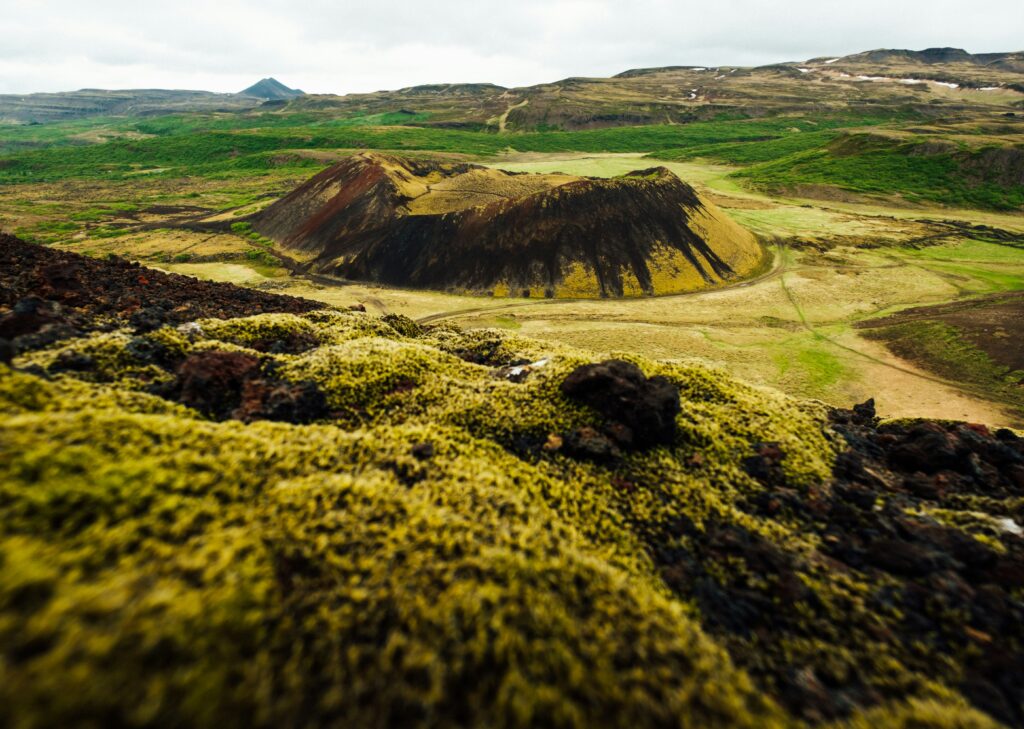
Icelandic moss grows at roughly 1 millimetre per year on volcanic soil. A patch covering a square metre may represent over 1,000 years of uninterrupted growth. Because the volcanic ground beneath it is poor, acidic, and slow to recover, a single footprint can destroy decades of biological work. In Iceland, the moss is not decoration. It is the foundation of every ecosystem that follows it.
The patch of moss you almost stepped on
You are looking at a carpet of soft green moss spread across a lava field. It looks recent. Fragile in the way that new things look fragile. You step around it almost by instinct.
That patch began growing sometime around the year 1100. The First Crusade had just ended. The University of Bologna, the oldest in the world, had been open for roughly two decades. Notre-Dame de Paris would not be built for another fifty years.
This is not hyperbole. It is the growth rate of certain Icelandic mosses: approximately 1 millimetre per year under optimal conditions. A cushion of moss 30 centimetres thick has been building itself, silently and continuously, for three centuries. The one you almost stepped on may be considerably older.
Iceland’s lava fields are some of the most recently formed land on Earth. The rock is young, bare, and chemically hostile to most life. Moss is among the first organisms capable of surviving on it. What you see as a soft green carpet is, ecologically speaking, the beginning of everything.
What icelandic moss actually is
Iceland hosts over 600 species of moss and lichen. The one most people picture, the dense green cushion that covers lava fields and hillsides, is primarily a mixture of feather mosses and true mosses adapted to cold, wet, acidic conditions.
Cetraria islandica, known as Iceland moss, is technically a lichen rather than a true moss. It has been used by Icelanders for centuries as food and medicine. Boiled into a gel, it soothes respiratory infections. Ground into flour, it supplements bread during food shortages. It appears in Icelandic pharmacopoeias going back to the 17th century. The plant that visitors treat as scenery sustained communities through centuries of volcanic winters.
What all these species share is their pace. In the brief Icelandic summer, which lasts roughly six to eight weeks at higher altitudes, moss accumulates perhaps a millimetre of growth. In winter, it does nothing. It waits. It has been waiting and growing on this island for thousands of years, longer in some cases than the written history of the people who live here.
Why one footprint takes a century to disappear
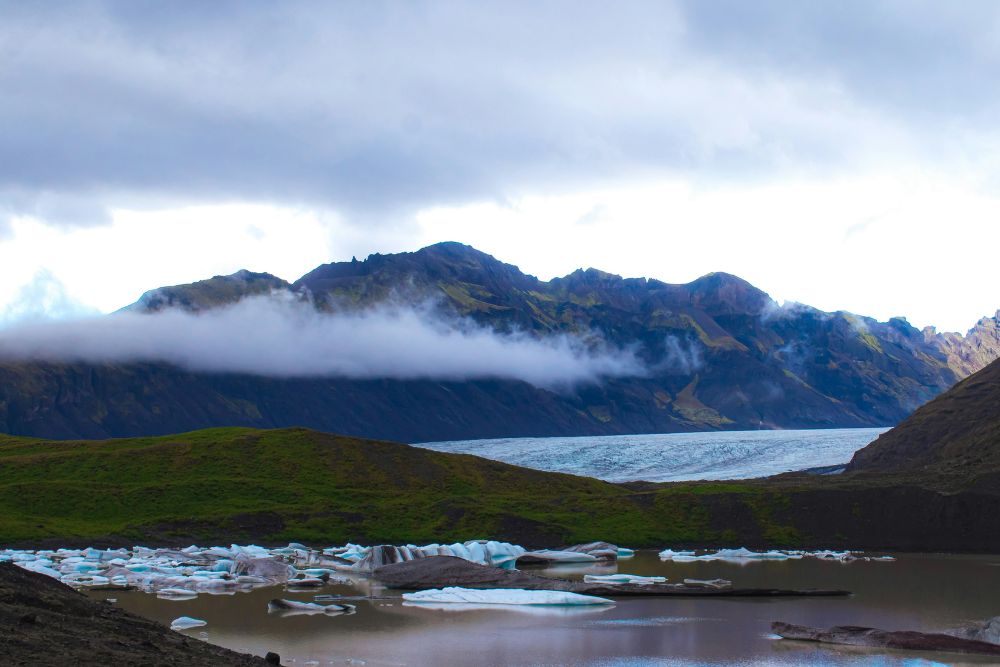
The volcanic soil beneath Icelandic moss is among the least fertile on Earth. It is thin, acidic, and almost entirely lacking in the organic matter that most plants need to establish themselves. Moss does not require this organic matter. It colonises bare rock directly, extracting minerals through chemical processes, trapping wind-blown particles, retaining moisture.
Over decades and centuries, a living moss layer builds what is called a cryogenic soil: a thin but functional growing medium that slowly accumulates enough organic content to support other plants. Grasses, sedges, and eventually small shrubs can establish themselves in the spaces the moss prepares.
A single footprint compresses this structure entirely. The cushion collapses. The fragile soil layer beneath it is compacted and disrupted. Moisture retention drops. The surface becomes inhospitable to the very organisms that built it.
Studies on Icelandic vegetation recovery suggest that heavily trampled moss takes between 20 and 100 years to return to its pre-disturbance state, depending on altitude, moisture, and the frequency of further disturbance. A path created by ten people walking the same line in a single day may still be visible a century later.
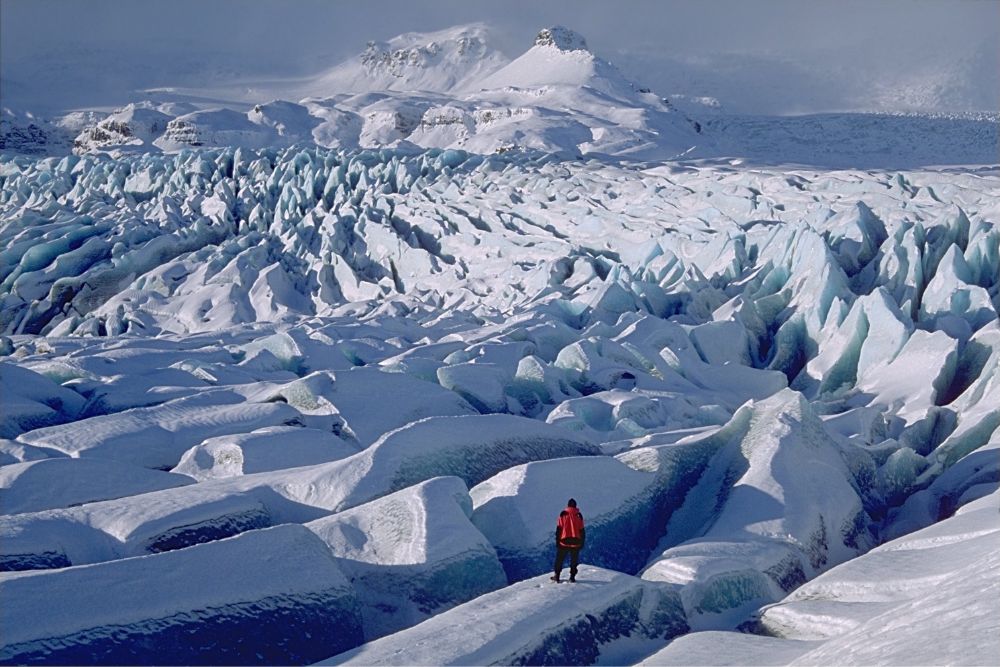
This is not unique to Iceland. The volcanic landscapes shaped by glacial processes across the island share the same fundamental fragility: young ground, slow biology, and no resilience to repeated physical impact.
The law, and what it cannot do
In Iceland, the destruction of protected vegetation is a legal offence. Fines can reach 150,000 Icelandic krónur, approximately 1,000 euros. Driving off-road is illegal across most of the country and carries significant penalties. The Icelandic Environment Agency maintains a list of protected areas where off-trail movement is restricted or prohibited entirely.
These rules exist because the damage they address is real and measurable. Aerial surveys of Icelandic highlands have documented the spread of erosion zones over the past thirty years, correlating directly with increases in visitor numbers and off-road movement.
But enforcement is difficult across a country the size of Kentucky with a population of 370,000 and roughly 2.2 million annual visitors. Rangers are few. The most damaged areas are often the most remote. The law defines the boundary. It cannot stand on every lava field.
What changes behaviour reliably is not the fine. It is understanding what the fine is for. A rule that says ‘do not step on the moss’ is a command. A fact that says ‘this moss is older than the cathedral you visited last week’ is a different kind of invitation entirely.
How to walk differently
The marked trails in Iceland are not arbitrary. They were placed by ecologists and land managers to route visitors through the least biologically sensitive corridors of a given landscape. Following them is not a restriction of your experience. It is access to the knowledge of people who have studied the ground for years.
Off-trail movement in Iceland is not inherently wrong. Geologists, botanists, and trained naturalists move through sensitive areas routinely, with specific training in minimising contact and reading the landscape before they step. The difference is not permission. It is preparation.
For the visitor, the practical shift is simpler than it sounds. Stay on marked paths. If no path exists, walk on bare rock where possible. Avoid stepping on any surface that is visibly soft, green, or cushioned. If you are unsure whether something is moss, assume it is.
The same attentiveness that makes reading a canyon’s geology possible makes walking carefully through a lava field possible. It is not about restriction. It is about switching from moving through a landscape to actually seeing it.
A thousand years in thirty centimetres
The next time you see Icelandic moss, you will know something that most people walking past it do not. That patch has been building itself, millimetre by millimetre, longer than most of the institutions and buildings we consider ancient.
Walking around it costs nothing. It requires no equipment, no extra time, no sacrifice. It only requires the decision to look at something small and understand that its size has nothing to do with its age.
Iceland does not ask you to be a geologist to travel it well. It asks you to pay attention. The moss is a good place to start.
Frequently asked questions
Why can’t you walk on moss in Iceland?
Icelandic moss grows at roughly 1 millimetre per year on poor volcanic soil. A single footprint compresses the structure and disrupts the fragile growing medium beneath it. Recovery takes 20 to 100 years. The damage is disproportionate to the convenience, and it accumulates across millions of visitors.
Is it illegal to damage moss in Iceland?
Yes. Destroying protected vegetation in Iceland is a legal offence. Fines can reach 150,000 Icelandic krónur, approximately 1,000 euros. Driving off-road is also illegal across most of the country. The regulations are enforced by the Icelandic Environment Agency and local rangers.
How old is Icelandic moss?
Individual moss cushions can be several hundred to over 1,000 years old, depending on species and growing conditions. Growth rates of around 1 millimetre per year are common for cushion-forming mosses in Iceland’s volcanic highlands. A 30-centimetre cushion represents roughly three centuries of continuous growth.