
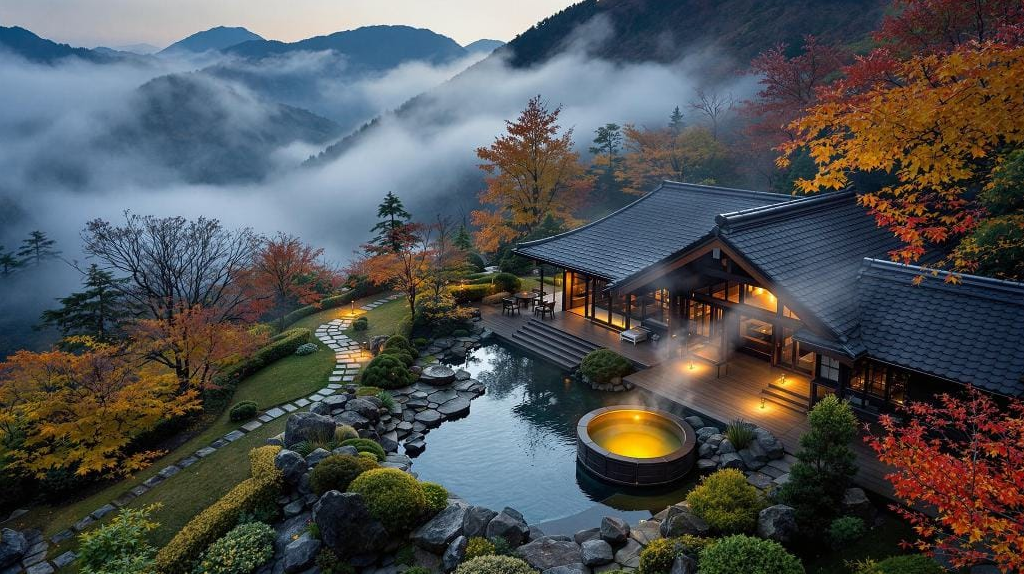
Hakone volcanic caldera at a glance
Hakone volcanic caldera is a complex collapsed volcano formed roughly 400,000 years ago. Its most active zone, Owakudani, still releases geothermal gases today. Lake Ashi sits on the caldera floor. The ryokan, the onsen, the ridge trails, they all exist inside this system. Japan’s most visited destination outside Tokyo is also one of its most geologically alive places.
The bath is 42 degrees and the window fogs over within minutes. Outside, the lake sits black and still below the room. The mountains around it are invisible in the dark but you felt them on the way in, the way the valley narrows, the way the air changes when you drop into the basin.
It is very quiet. Very comfortable. The kind of place you come to in order to stop thinking.
And yet, a few kilometers beneath the tatami mat, a magma chamber sits in partial heat, the remnant of a volcanic system that has been active for 400,000 years and shows no clear sign of stopping. The water in the bath is the temperature it is because of that chamber. The steam on the window comes from the same source as the vents at Owakudani. The silence of the lake is the silence of a caldera floor.
You checked in to a ryokan. You are sleeping inside a volcano.
Hakone Volcanic Caldera: A Quick Overview
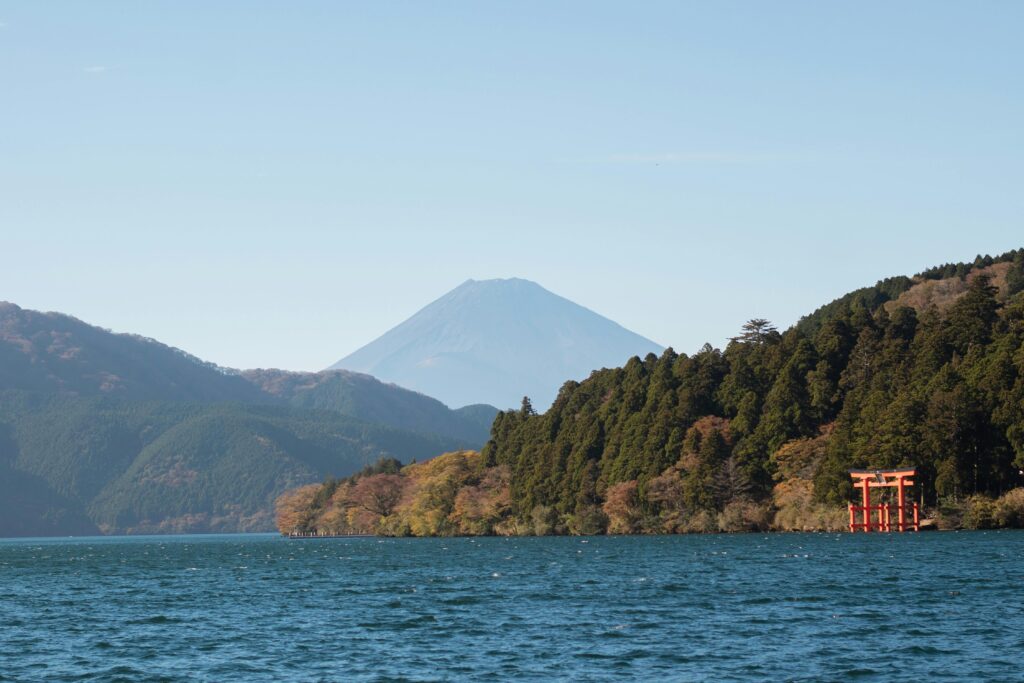
Hakone has a well-established identity in the minds of visitors. It is the onsen town two hours from Tokyo. It is where you go to see Mount Fuji reflected in a lake, if the clouds cooperate. It is sliding doors and ceramic cups and the sound of water moving through wooden pipes. It is rest.
None of that is wrong. The rest is real. The sliding doors are real. The reflection, when it appears, is genuinely beautiful.
But the identity is incomplete in a way that matters. Hakone volcanic caldera is not the backdrop to the experience. It is the experience. The mountains that make the valley intimate are the caldera walls. The lake that catches the light is sitting in the collapse zone. The water that fills every bath in every building in this basin rose through fractured volcanic rock before it reached the pipe. The place and the geology are not separate things. They are the same thing, seen from different angles.
Most visitors never make that connection. Hakone does not require it. The comfort works either way. But something shifts when you understand where you actually are.
What Lies Beneath the Hakone Volcanic Caldera
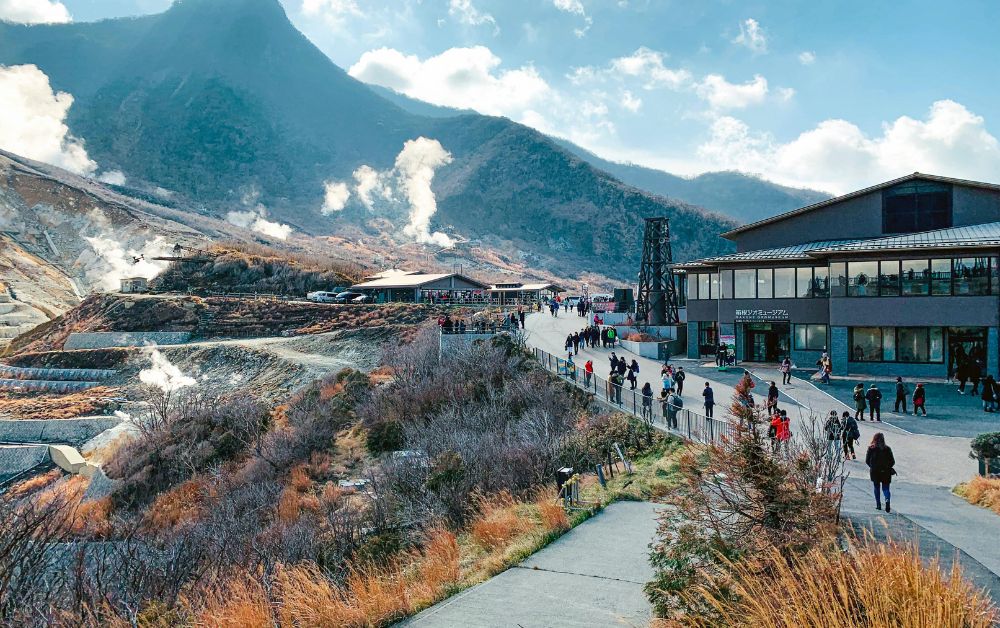
At Owakudani, in the northeastern part of the caldera, the ground does not hide what it is. Fumaroles push steam through cracks in the hillside. The soil is yellow with sulfur deposits. The smell reaches you before the view does. This is the place where Hakone’s geology breaks the surface visibly, where the process happening several kilometers down becomes something you can see, smell, and feel as heat against your face.
The Japan Meteorological Agency monitors Owakudani continuously and publishes current alert levels on the JMA volcanic activity page. The monitoring exists because the system is active. Not dangerous in the everyday sense of the word, but alive in the technical sense. The gases escaping through the vents carry chemical traces of the magma-water interaction happening at depth. Volcanologists read them the way a doctor reads a pulse.
The same energy, softer and further from the surface, feeds every onsen in the valley below. The water in the public baths and the private rooms of the ryokan is rainwater that percolated through volcanic rock, was heated at depth, and returned to the surface. Different springs carry different mineral signatures depending on the rock they passed through on the way. The water in your bath has a geological history. It traveled to reach you.
A Culture Built on Geological Acceptance
Japan has 110 active volcanoes. Four tectonic plates converge beneath the archipelago. Earthquakes are measured not in whether they happen but in how strong. This is not a country that chose a difficult geological situation and adapted to it. It is a country that formed inside that situation, and built everything, architecture, agriculture, ritual, philosophy, around the reality of living on unstable ground.
Hakone is a concentrated expression of that relationship. The onsen culture that makes this place what it is did not develop despite the volcanic activity. It developed because of it. The hot springs are geothermal. The mineral-rich water has been used for bathing and healing for over a thousand years. The ryokan, the particular form of hospitality that Hakone perfected, is designed around the bath. The bath is designed around the spring. The spring comes from the volcano.
There is a concept in Japanese aesthetics called mono no aware: the gentle sadness of impermanence, the beauty of things that do not last. Volcanic landscapes carry that quality naturally. Owakudani will not always look the way it does today. The caldera will continue to shift. The lake level changes over geological time. What exists now is a particular moment in a process that began long before any human arrived and will continue long after.
Yakushima holds a different version of the same lesson. Where Hakone teaches coexistence with heat and instability, Yakushima teaches patience with deep time. Both places ask the same question: what does it mean to be a guest on a landscape that was never waiting for you?
What Hakone Teaches
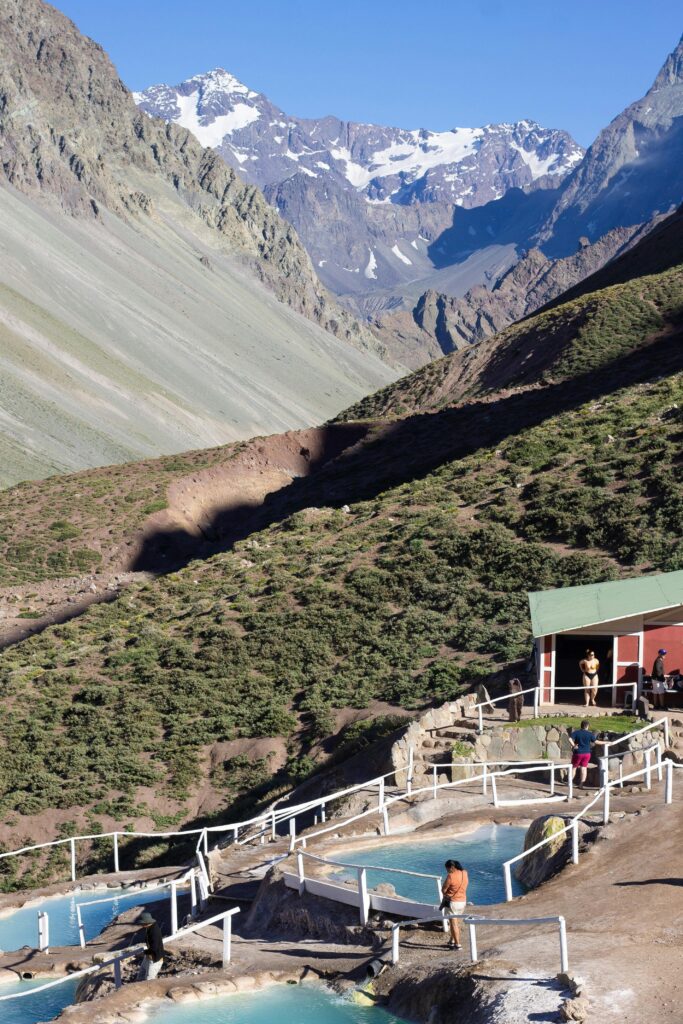
The lesson is not about geology specifically. It is about the distance between what a place appears to be and what it actually is.
Hakone appears to be a place of rest. It is also a place of continuous geological activity. These two things are not in tension. They are the same place described from different distances. Close up, it is tatami and warm water and the sound of rain on a roof. Pulled back, it is a volcanic caldera with a functioning geothermal system and an alert level maintained by the national meteorological agency.
Both descriptions are accurate. Neither is more true than the other. What changes is what you do with the knowledge.
A traveler who knows they are sleeping inside a Hakone volcanic caldera does not sleep worse. They sleep with more information. The warmth of the bath means something additional. The steam at the window is not just atmosphere. The ridge visible at dawn is not just scenery. The place becomes more itself, not less comfortable, when you understand it.
That is what Geonatra means when it says the Earth is the hero. Not that the science replaces the experience. That the science deepens it. Hakone is proof that this works. The most visited place in Japan outside Tokyo is a caldera. People come for the rest. They could leave understanding what rest, in this particular place, is built on.
For the geological itinerary that gives Hakone its wider context sits within the full arc of Japan’s volcanic landscape. And for the specific science that connects Hakone’s hot springs to the broader geothermal system, the science behind Japan’s hot springs follows the water from the surface to the magma and back.
For Young Explorers
Why is the bath water hot at Hakone? Because deep underground, very hot rock warms the water as it passes through. That rock is hot because Japan sits on top of places where giant pieces of the Earth’s surface are slowly sliding under each other, producing heat as they go. The bath is connected, through the rock, all the way down to that process. The farther down you imagine, the hotter it gets.
Frequently Asked Questions
Can you stay overnight in Hakone safely?
Yes. Hakone is monitored continuously by the Japan Meteorological Agency. The volcanic activity at Owakudani is ongoing but managed. Trail access occasionally closes during elevated periods, as it did briefly in 2015 and 2019. Checking the JMA alert level before visiting takes two minutes and answers the question with current data.
What makes Hakone different from other onsen towns in Japan?
Most onsen towns in Japan sit near geothermal sources. Hakone sits inside one. The entire basin is a volcanic caldera, which means the hot springs, the landscape, the lake, and the ridgelines are all part of the same geological system. That relationship between place and geology is unusually direct and unusually legible.
Is Owakudani worth visiting?
Yes, because it is the one place in Hakone where the geology stops being background and becomes foreground. The fumaroles, the sulfur deposits, the monitoring stations, the view back over the caldera — it gives the whole visit a different frame. Check the JMA alert level before going, as access to the summit area occasionally closes.
About the author Daniel is the founder of Geonatra and writes about Earth science for curious travelers. He has explored volcanic landscapes across Japan, Iceland, and Central America, with a focus on making geology accessible without making it simple.