Japan sits above the convergence of four tectonic plates: the Pacific, Philippine, Eurasian, and Amur plates. This collision zone makes Japan one of the most seismically active places on Earth, recording around 1,500 earthquakes per month. Most are imperceptible. All of them are the same geological story, told in motion.
It is 3 a.m. in a Tokyo hotel room. The glass of water on the nightstand trembles slightly. The building sways, just barely, for four seconds. Then stillness. No alarm sounds. No one gets up. By morning, nobody mentions it.
Japan records roughly 1,500 earthquakes every month. For most residents, a small tremor is less remarkable than a delayed train. But for anyone visiting from outside the Ring of Fire, that quiet reaction raises an immediate question: why here? Why does this country shake so often, and with such force?
The answer is not found in Japanese history or culture. It is written in the rock beneath the islands themselves.
Japan Tectonic Plates: 4 Plates, 1 Country
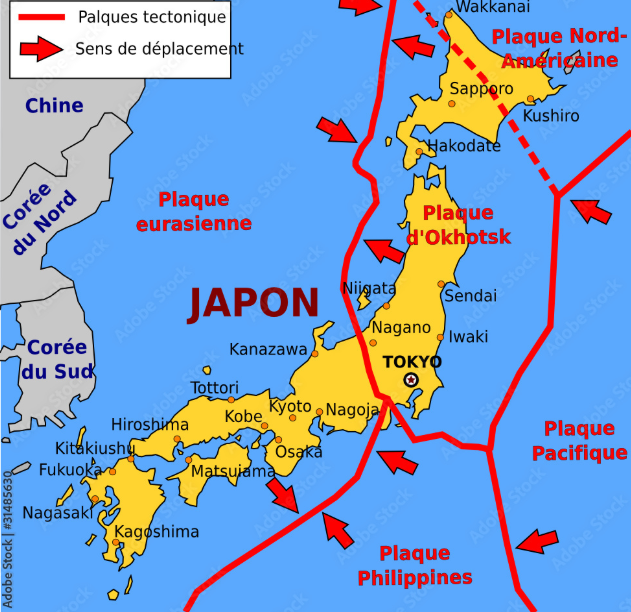
Most of the world sits comfortably on a single tectonic plate. Japan does not. The archipelago sits at the convergence of four: the Pacific Plate to the east, the Philippine Plate to the south, the Eurasian Plate to the west, and the Amur Plate beneath much of Honshu.
Each of these plates is in constant motion, moving centimeters per year in different directions. That may sound slow, but over millions of years it produces some of the most dramatic geology on Earth.
If you followed Geonatra’s coverage of Iceland in Season 1, you know what a mid-ocean ridge looks like: two plates pulling apart, magma rising to fill the gap, new crust forming at the seam. Japan is the structural opposite. Here, plates are not moving away from each other. They are colliding. Iceland: When Did This Island Actually Form? [
That difference in mechanism explains everything that follows.
Japan Tectonic Plates and Subduction
When an oceanic plate meets a continental or another oceanic plate, one of them loses. The denser plate bends downward and sinks into the mantle in a process called subduction. Under Japan, the Pacific Plate is doing exactly that, descending beneath the Eurasian Plate at a rate of about 8 to 9 centimeters per year.
As it descends, friction between the two plates builds stress in the rock above. That stress does not release smoothly. It accumulates over decades, sometimes centuries, and then releases in seconds. That release is what we call an earthquake.
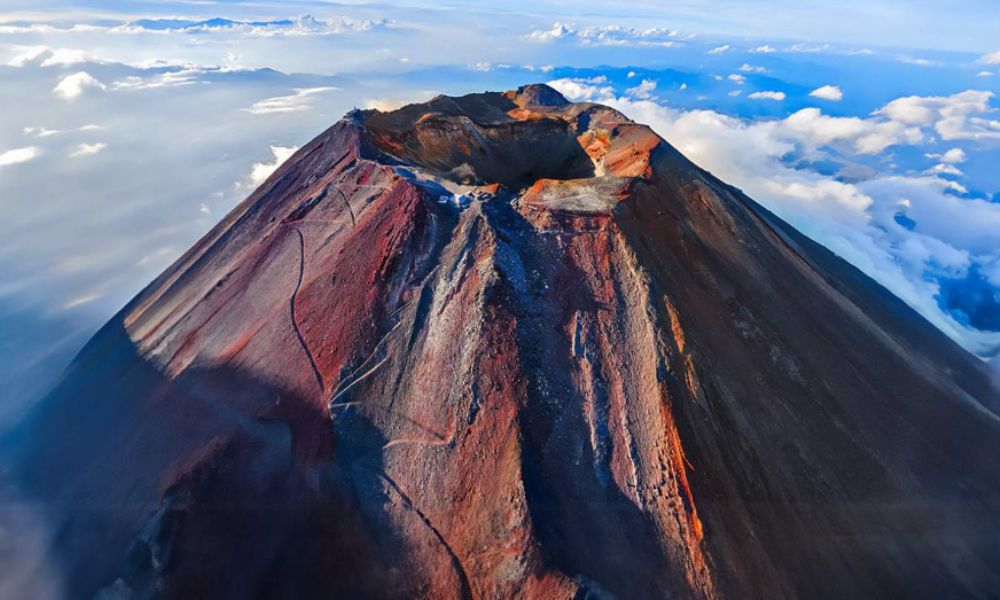
The descending plate also carries water into the mantle. Water lowers the melting point of rock. Melted rock rises. Where it reaches the surface, you have a volcano.
This is why Japan has both. The earthquakes and the volcanoes are not separate phenomena. They are the same process, expressed differently.
Why Tokyo and not Paris? Because Paris sits near the stable interior of the Eurasian Plate, far from any active plate boundary. Tokyo sits directly above one of the most active subduction zones on the planet. The geology of where you are born determines whether a trembling glass of water is alarming or routine.
The Numbers That Put It in Perspective
According to the Japan Meteorological Agency, Japan registers around 1,500 seismic events per month. The vast majority measure below magnitude 3 and go unnoticed without instruments. Perhaps 10 to 15 per month are felt by people near the epicenter.
The major events are rarer, but the historical record is sobering. The 1923 Great Kanto Earthquake killed more than 100,000 people in the Tokyo-Yokohama region. The 2011 Tohoku earthquake, measuring magnitude 9.0, generated a tsunami that reshaped the northeastern coast.
These events are not anomalies. They are the expected output of a subduction zone that has been active for millions of years. Understanding that does not diminish the human tragedy, but it reframes the question. Japan does not shake because something is wrong. It shakes because of exactly what the geology here is supposed to do.
To understand how this same subduction shapes Japan’s volcanoes from Hokkaido to Kyushu, Japan’s Volcanoes: A Beginner’s Guide
Frequently Asked Questions
Why Japan Has Earthquakes and Volcanoes?
Japan sits at the intersection of four tectonic plates. The constant pressure and movement between these plates generates stress in the crust, which releases as seismic activity. It is one of the densest plate boundary zones on Earth.
Is Japan safe to visit because of earthquakes?
Japan has among the most advanced earthquake preparedness systems in the world, including early warning networks, strict building codes, and regular public drills. Small tremors are common and pose no danger to visitors. The Japan Meteorological Agency provides real-time alerts for significant events.
What is the difference between Japan’s volcanoes and Iceland’s?
Iceland’s volcanoes form above a mid-ocean ridge, where plates pull apart and magma rises to fill the gap. Japan’s volcanoes are the product of subduction: one plate descending beneath another, generating heat and melted rock that rises to the surface. Same result on the surface, opposite mechanisms below.