
Most travelers who end up in Page, Arizona come for one photograph. Either the light beam in Antelope Canyon, or the 300-meter drop at Horseshoe Bend. They stay for a day, maybe two, and leave convinced they have seen Page. In reality they have seen the trailers for a much longer film. This complete Page Arizona travel guide is for the traveler who wants the full picture: what the land is doing here, which sites are worth your time, when to go, and how to put a real itinerary together that respects both the landscape and the Navajo Nation that owns most of it.
Why Page, Arizona Exists at All
Page is a young town built for an old reason. It was founded in 1957 as a workers’ camp for the construction of the Glen Canyon Dam, which was completed in 1966. Before the dam, the area was almost empty: a windswept plateau of red sandstone with the Colorado River cutting through it 300 meters below. After the dam, the river backed up to form Lake Powell, the second-largest reservoir in the United States, and Page became the service town for the dam, the lake, and eventually the explosion of tourism that followed.
The town itself has fewer than 8,000 permanent residents, but it serves as the gateway for roughly 4 million visitors per year to the surrounding sites. Everything in a 50-kilometer radius of Page sits on land that was shaped by three forces: ancient sand dunes that became stone, the Colorado River that cut through them, and the Colorado Plateau that lifted the whole package roughly 2 kilometers above sea level.
The Geology Behind Everything You’ll See
Almost every landmark around Page, Arizona is cut into the same rock: the Navajo Sandstone. This formation was deposited around 180 million years ago, when the entire area was a Sahara-sized desert of windblown dunes. Over millions of years, the dunes piled up to a depth of nearly 600 meters, got buried, cemented together, and turned into stone. The characteristic cross-bedding you see in the walls of Antelope Canyon, the orange-pink color of Horseshoe Bend, and the slickrock surface of the plateau itself are all signatures of that ancient dune field.
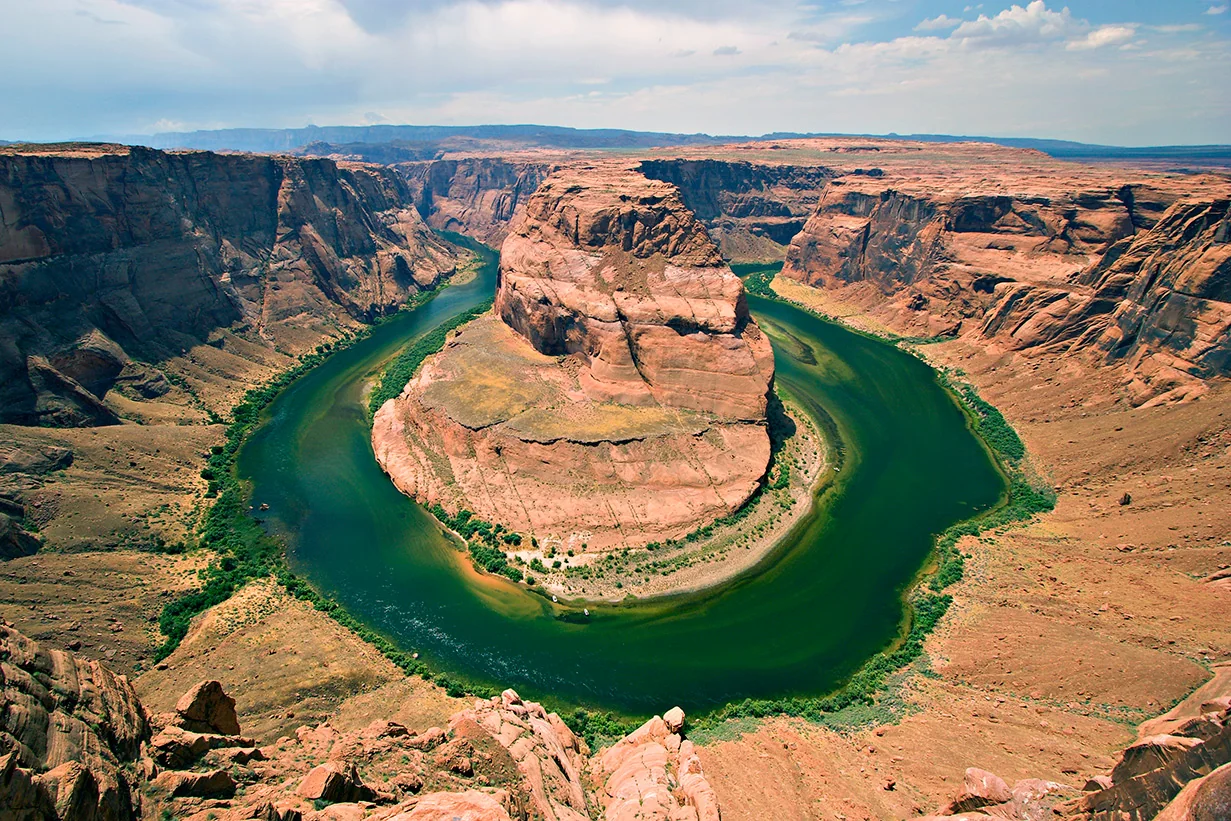
The sculpting came much later. The Colorado River began carving its modern canyon system roughly 5 to 6 million years ago, cutting down through the sandstone as the Colorado Plateau was uplifted. Horseshoe Bend is a frozen snapshot of that cutting in action: a meander locked in place because the river could not shortcut through walls that hard. Antelope Canyon is a different story, carved not by the river but by flash floods from the surrounding uplands rushing through a crack in the sandstone, polishing it into those famous curves.
The Essential Sites Around Page
1. Antelope Canyon (Upper, Lower, Rattlesnake)
The most famous site in the Page area, and almost certainly the reason you heard of this town. Antelope Canyon is a slot canyon on Navajo land, accessible only through authorized Navajo guides. Upper Antelope is the easier walk and the one where the famous light beams appear around midday from late March to early October. Lower Antelope is longer, narrower, and requires descending metal stairs. Rattlesnake Canyon is less crowded and the newest tour option.
Full details on timing, costs, and which tour to pick are in our dedicated guide to Antelope Canyon Arizona, and the camera gear considerations are in camera gear for Antelope Canyon.
2. Horseshoe Bend
A near-perfect 270-degree meander of the Colorado River, 300 meters below the sandstone rim. The overlook is a short 1.2-kilometer walk from the parking area and sits just 6.5 kilometers south of Page off U.S. Route 89. Parking costs around $10 per vehicle. Our complete Horseshoe Bend Arizona guide covers best timing (sunrise or late afternoon), the drop with no railing on most of the rim, and how to combine it with Antelope Canyon in a half-day.
3. Lake Powell
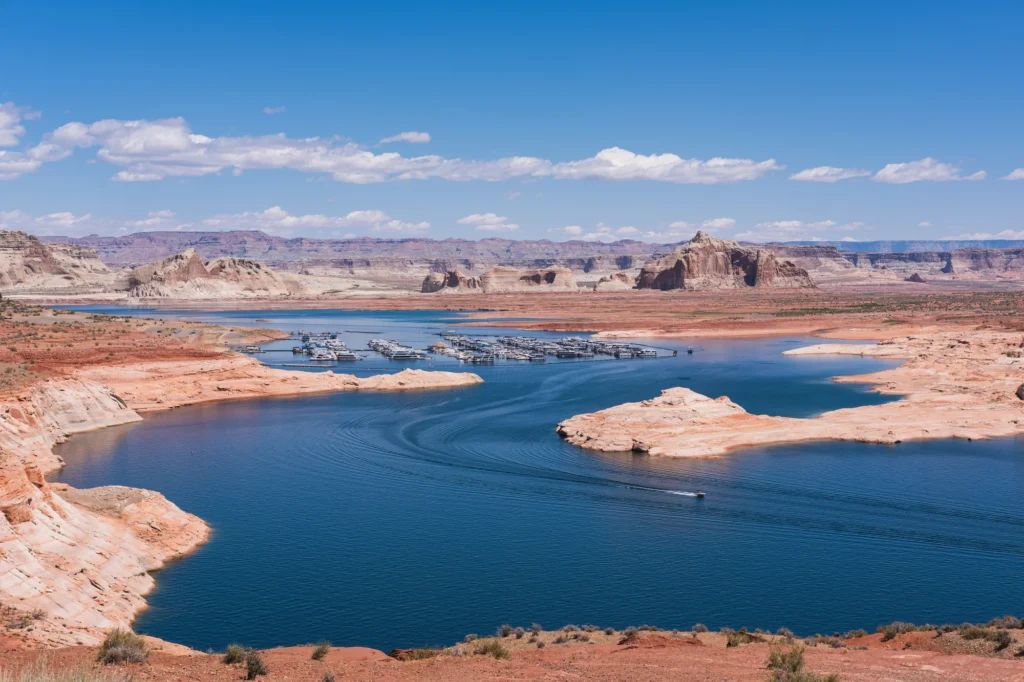
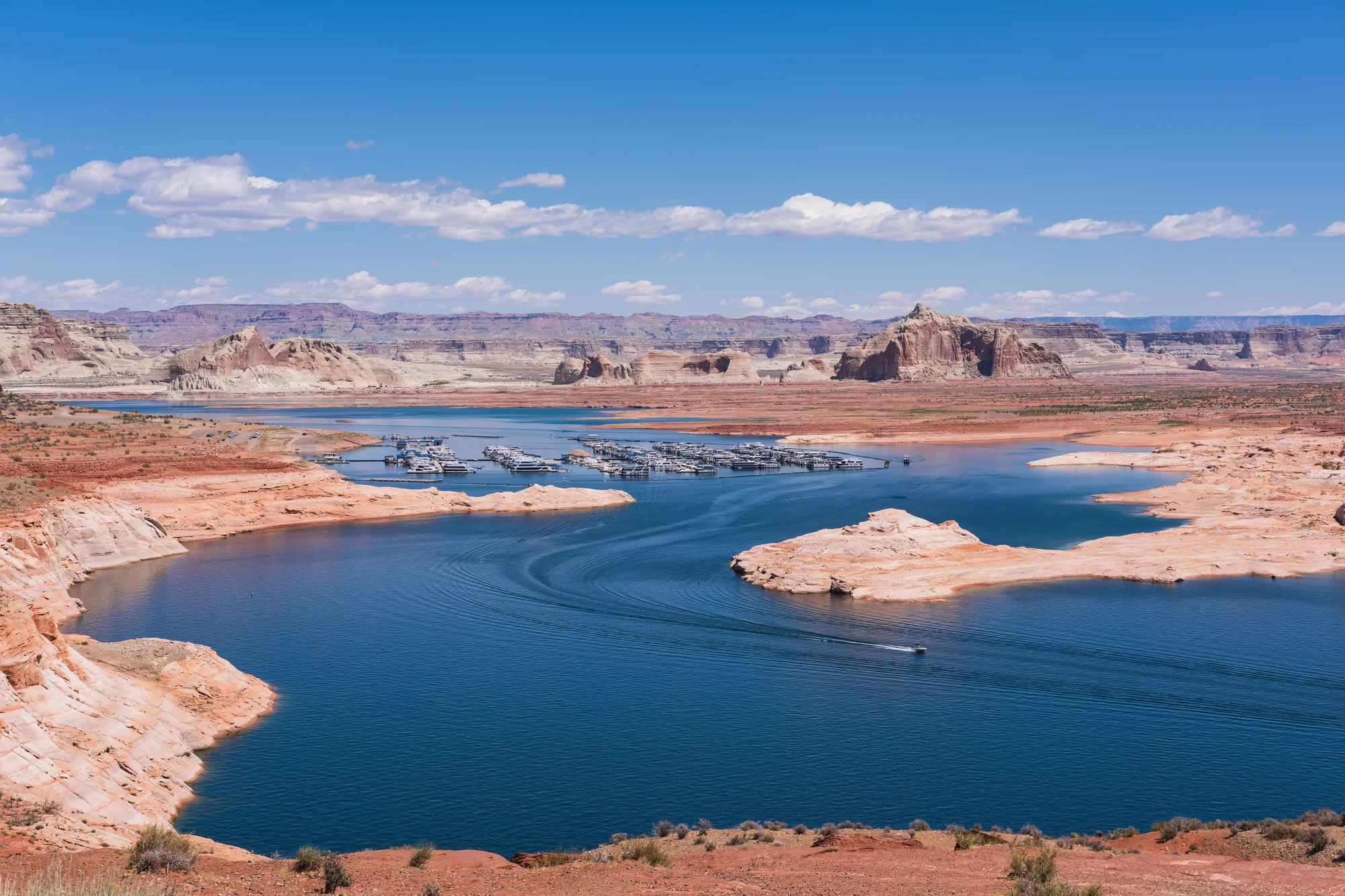
The reservoir created by Glen Canyon Dam, Lake Powell stretches 300 kilometers upstream into Utah and contains more than 2,000 kilometers of shoreline, almost all of it carved into sandstone. The lake is spectacular on its own but also the only practical way to reach Rainbow Bridge, the largest natural bridge in the world. Half-day and full-day boat tours leave from Wahweap Marina on the west side of Page. If you only have one lake experience in your Page itinerary, make it a boat tour into one of the slot-canyon arms of the lake.
4. Glen Canyon Dam
The reason Page exists. Completed in 1966, the dam is 216 meters tall and sits in a dramatic concrete arc at the bottom of Glen Canyon. The visitor center on U.S. Route 89 offers free self-guided viewpoints and paid guided tours into the dam itself. The engineering is worth seeing, but the real draw is the perspective: standing on the Carl Hayden Visitor Center observation deck, you look down 200 meters at the river that has been flowing for millions of years and the structure that has stopped it for sixty.
5. Rainbow Bridge National Monument
At 88 meters tall and 83 meters wide, Rainbow Bridge is the largest natural bridge in the world. It is only accessible by boat (a 50-mile round trip across Lake Powell from Wahweap Marina) or by a strenuous backcountry hike across Navajo land requiring a permit. Most visitors take the full-day boat tour, which includes the bridge, a short walk to the viewpoint, and a return across the lake. It is also deeply sacred to the Navajo, Hopi, and other local nations: visitors are asked not to walk directly under the arch out of respect.
6. Grand Canyon South Rim (Day Trip)
The Grand Canyon South Rim is about 2.5 hours south of Page by car, which makes a long day trip possible if you leave by sunrise and are back late. A better plan is to spend one night at Grand Canyon Village and treat it as a separate stop. For hikers, our deep dive into the Grand Canyon South Rim to river hike covers what rangers call the most deceptive day hike in America.
A Realistic 48-Hour Itinerary
Most visitors give Page one night. If you have two, here is a sensible way to use them without burning out.
Day 1 morning: Antelope Canyon tour, booked for 10 AM to 12 PM (light beam window if visiting March to October). Lunch in town.
Day 1 afternoon: Drive 15 minutes south to Horseshoe Bend. Walk out mid-afternoon so you are at the rim for golden hour. Return to town for dinner.
Day 2 morning: Glen Canyon Dam visitor center and guided tour (90 min). Then drive to Wahweap Marina and board a half-day boat tour into one of the slot canyons of Lake Powell (3 to 4 hours including transit).
Day 2 afternoon: Short drive to the Toadstool Hoodoos trailhead (30 min north of Page) for an easy 1.5-mile round-trip hike through unusual mushroom-shaped rock formations. Return to Page or continue north toward Bryce Canyon.
When to Visit Page, Arizona
The sweet spot is April to May and September to October: warm but not blistering, longer days, lower crowds than peak summer. July and August bring extreme heat (daytime highs regularly above 38°C), monsoon flash flood risk in slot canyons, and the biggest crowds of the year. November to March is quiet and dramatic, with cold mornings, short days, and the occasional snow dusting on the red rock. Winter rates on hotels and tours can be 30 to 50 percent lower than high season.
For the Antelope Canyon light beams specifically, aim for late March through early October between 11 AM and 1 PM. Outside that window the beams do not form at all, though the canyon is still worth visiting for its curves and color.
How to Get to Page
Page has a small regional airport with limited commercial service, so most visitors arrive by car. The practical starting points are:
- Las Vegas: 4.5 hours by car via Flagstaff
- Phoenix: 4.5 hours by car via Flagstaff
- Grand Canyon South Rim: 2.5 hours
- Zion National Park: 2 hours
- Bryce Canyon: 2.5 hours
- Monument Valley: 2 hours
Page is almost always a stop within a larger Southwest road trip rather than a destination in itself. If you are flying in and renting a car, Las Vegas is the easiest hub with the most car rental options.
Where to Stay
Page itself has about 25 hotels and motels, concentrated along N. Lake Powell Boulevard and the ridge above the Glen Canyon Dam. The most interesting lodging is at Lake Powell Resort (right on the water at Wahweap Marina) and a handful of smaller independent inns in town. Vacation rentals are plentiful through Airbnb and Vrbo for groups. Our dedicated advertorial on Where to Stay in Page Arizona compares the 7 best eco-conscious options with current rates (coming soon in this cluster).
Respecting the Navajo Nation
Most of the dramatic landscapes around Page sit on Navajo Nation land, including Antelope Canyon, Rainbow Bridge, and large parts of the plateau. The Navajo Nation operates on its own tribal time zone (observes daylight saving when Arizona does not), has its own permit system, and expects visitors to behave as guests on sovereign land. Specifically: Antelope Canyon can only be entered with a Navajo-authorized guide, Rainbow Bridge should not be walked under out of respect, and off-trail wandering on tribal land requires a backcountry permit from the Navajo Parks and Recreation Department. Approach every site here with the understanding that the land is not public park, it is somebody’s country.
Frequently Asked Questions
How many days do you need in Page, Arizona? One full day covers Antelope Canyon and Horseshoe Bend, which is what most visitors do. Two days lets you add Lake Powell by boat and Glen Canyon Dam without rushing. Three days opens up Rainbow Bridge and a day trip to Grand Canyon South Rim or Monument Valley.
Is Page Arizona on Navajo time? Page itself observes Arizona time (no daylight saving), but the Navajo Nation surrounding Page observes daylight saving. This matters mostly for Antelope Canyon tour times, which usually run on Navajo time. Always double-check with your operator which time zone your booking uses.
Can you see Antelope Canyon without a guide? No. All sections of Antelope Canyon are on Navajo land and require booking a guided tour through an authorized operator. There is no self-guided access.
What is the closest airport to Page, Arizona? Page Municipal Airport has limited commercial flights, mostly seasonal connections to Phoenix. For reliable options, fly into Las Vegas (4.5 hours by car), Phoenix (4.5 hours), or Flagstaff (2.5 hours).
Is Page safe for solo travelers? Yes. Page is a small, quiet town with low crime, and the main sites are busy with visitors throughout the day. The usual precautions apply at Horseshoe Bend regarding the drop. Solo female travelers report feeling comfortable in Page.
This article contains affiliate links. Geonatra may earn a commission on qualifying purchases at no extra cost to you. Read our full affiliate disclosure.
About the Author
Elena Marsh writes Geonatra’s Places and Tools series, chasing landscapes rare enough to stop a scroll. She has driven in and out of Page three times from three different directions (Las Vegas, Grand Canyon South Rim, and Bryce Canyon), and still thinks the best entry is coming down U.S. 89 from the north with Lake Powell appearing between the cliffs. She works with Geonatra’s geologists to keep every recommendation grounded in what the land is actually doing, and with local operators to keep the practical advice honest.