
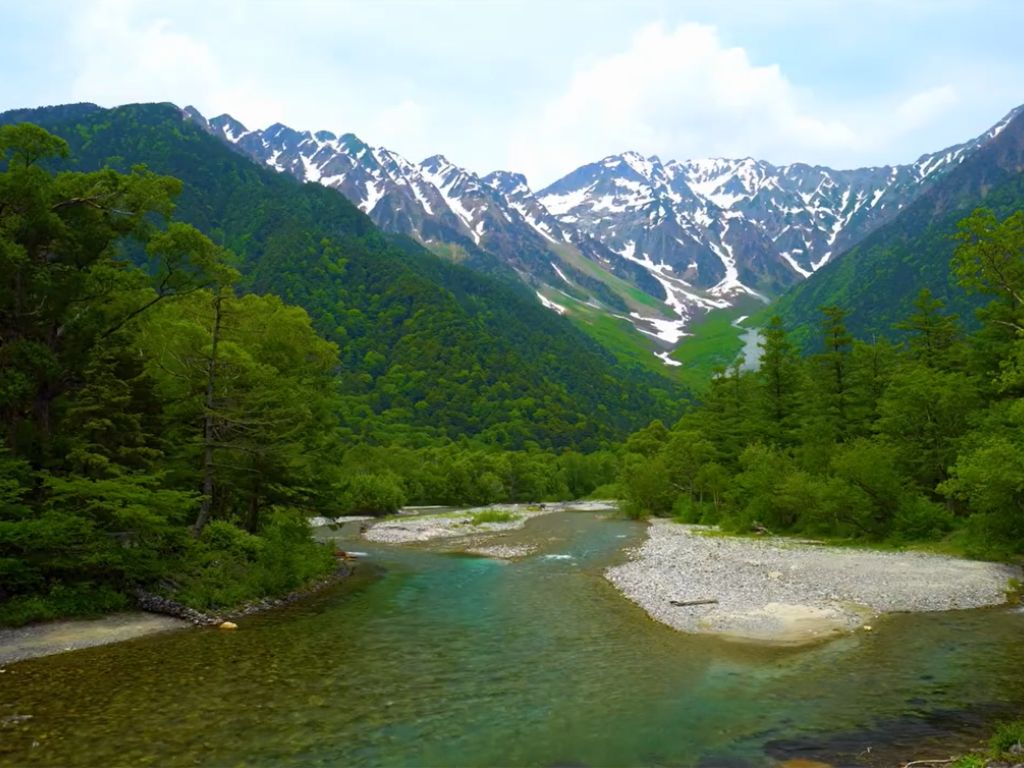
The Japanese Alps tectonic collision built peaks that look volcanic but aren’t. Kamikōchi, late August. The valley opens between cedar slopes and a high grey wall above. A hiker stops at the river’s edge, looks up at the Hotaka Range and thinks volcano. Three thousand metres of grey rock, sharp ridgeline, snow patches still hanging in the gullies in summer. The first instinct is to file it next to Mount Fuji.
It is not a volcano. It has never been a volcano. The grey is not andesite, it is granite. The shape was not built by erupting magma, it was lifted from below by a slower, quieter force that has nothing to do with the arc. The Japanese Alps are a separate chapter of the same archipelago, and the chapter is worth reading on its own terms.
Japanese Alps Geology Explained
Japanese Alps geology explained in fifty words: three north-south ranges in central Honshu (Hida, Kiso, Akaishi) lifted over the last few million years by compression between the Philippine Sea Plate and the Eurasian Plate. The peaks are exhumed granite from deep in the crust. They are tectonic mountains, not volcanic ones. What makes the japanese alps tectonic collision unique is its silence — no eruption, no smoke, just slow vertical lift.
Three Ranges, One Compression
The Japanese Alps are three connected ranges along the spine of central Honshu.
The northern range, the Hida Mountains, runs from Toyama down past Matsumoto and includes Mount Yari and the Hotaka group. The central range, the Kiso Mountains, sits just south and includes Mount Kisokoma and Mount Komagatake. The southern range, the Akaishi Mountains, stretches further south and rises to Mount Kita, the second-highest peak in Japan after Fuji. Together they cover much of central Honshu and form the country’s main alpine belt.
The mechanism that built them is not the arc volcanism that built Fuji and Hakone. It is a different geometry of plate motion.
To the south of central Honshu, the Philippine Sea Plate is moving northwestward and slipping under the Eurasian Plate. Where the Pacific Plate is doing the same thing further east, it is sinking deep into the mantle, melting and feeding the volcanic arc. The Philippine Sea Plate, slower and shallower, does something different: it presses the crust above it from the south, squeezing the rock into a vertical pile. Over the last three to five million years, that compression lifted the central spine of Honshu by several thousand
metres. It is also part of the same compression that drives Japan’s earthquakes along the Nankai Trough further south. For the wider arc story behind these forces, see the Japan’s Volcanoes guide.
Why These Mountains Are Made of Granite, Not Andesite
![Two grey rocks, two stories. Granite (Right) cooled deep underground over millions of years. Andesite (left) cooled near the surface in days.]](https://geonatra.com/wp-content/uploads/2026/05/side-by-side-close-up-of-pale-Japanese-Alps-granite-and-grey-Mount-Fuji-andesite.jpg)
If you pick up a stone in a Japanese alpine river, it usually feels different from a stone picked up at the foot of Mount Fuji. Fuji is grey andesite, fine-grained, born from arc magma that rose, cooled quickly near the surface, and is still building today. The Japanese Alps are a coarser rock altogether. Their bedrock is dominated by granite and related plutonic rocks: light-coloured, speckled with quartz, feldspar and dark mica, formed deep in the crust by magma that cooled slowly over millions of years.
Granite does not appear at the surface by accident. It cools at depths of several kilometres, sometimes tens of kilometres, well below where lava flows. For a granite massif to form a 3 000-metre peak, two things have to happen. The deep magma chamber has to crystallise quietly into rock. Then the kilometres of rock above it have to be removed, by a combination of tectonic uplift and surface erosion, until the granite is exposed and pushed even higher. That double process is exactly what the Geological Survey of Japan describes for the Hida Belt and surrounding ranges.
The Japanese Alps are not built by erupting magma. They are exhumed bones of an older crust, lifted into the air. They are a different chapter of the same plate story that produces the basalt and andesite of Japan’s volcanic arc. Reading the japanese alps tectonic collision in the field means looking past the volcanic-shaped peaks.
Why Japanese Alps Tectonic Collision Is Different
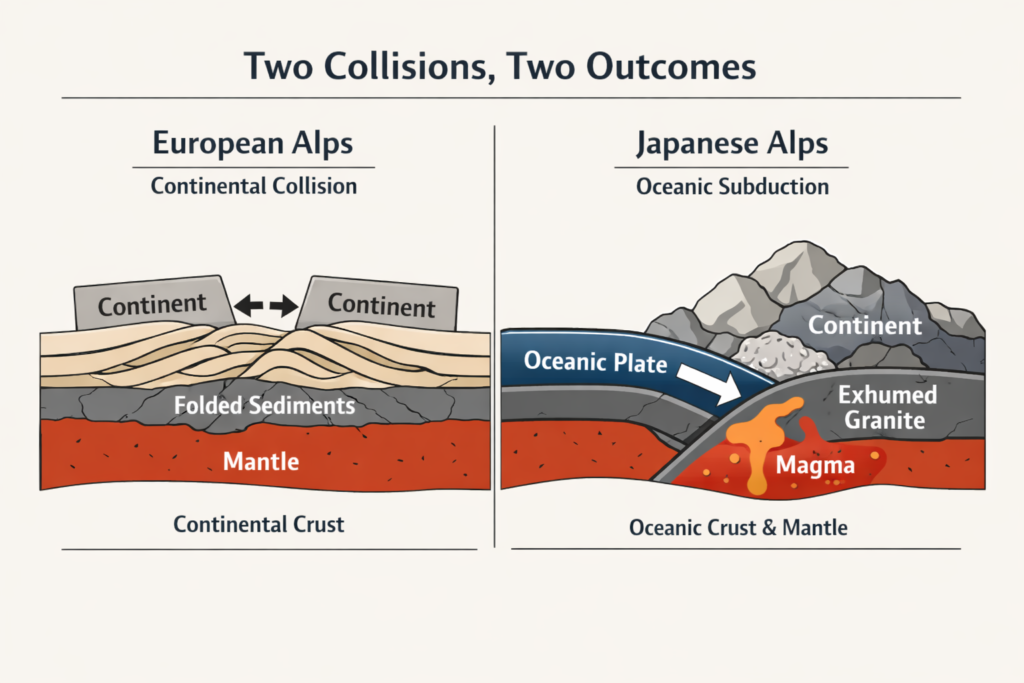
The European Alps were built by a different mechanism again. In southern Europe, the African Plate has been pushing north against the Eurasian Plate for tens of millions of years. Both plates are continental, both are thick and buoyant, and neither one can sink under the other. So they crumple. Layers of sediment that were once on the seafloor of an ancient ocean are now folded into the high ridges above Chamonix or Innsbruck. The Alps are mostly limestone, schist and gneiss, and they hold the fossils of marine creatures at three thousand metres.
The Japanese Alps are different. The Philippine Sea Plate is oceanic, denser, and it does sink under the continental crust above it. So the collision is not symmetrical. There are no folded layers of ancient seafloor at the summit, no marine fossils on Hotaka. The compression is real, the uplift is real, but the geometry produces a more compact, granitic range without the long fold-and-thrust belt of the European Alps. Same family of phenomena, different ingredients. That’s Why Japanese Alps Tectonic Collision Is Different
The story of japanese alps tectonic collision spans millions of years of squeeze between continental plates.
Reading the Landscape From an Alpine Onsen
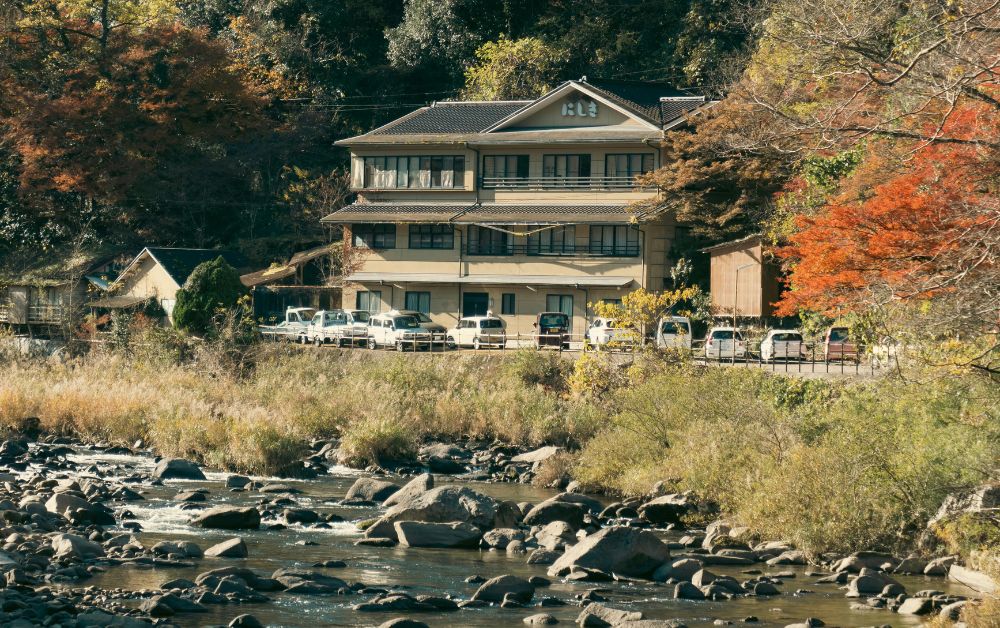
Once the geometry is in mind, the alpine valleys read differently.
Stand in Kamikōchi at first light and the gradient is the first thing you notice. The Azusa River descends from the Hotaka ridge in less than ten kilometres, dropping a vertical kilometre in that distance. That steepness is the signature of a young, still-rising range. The same is true at Hakuba, on the western flank of the Hida Mountains, and around Norikura. The water has not had enough time to carve a gentle profile, and the rock is being pushed up faster than the rivers can wear it down.
The hot springs of these valleys are also a hybrid. Some are fed by the same arc geothermal system that warms Hakone, where Philippine Sea Plate magma sits below. Others sit closer to pure tectonic uplift, where deep groundwater is heated by the depth and friction of the crust itself rather than by an active magma chamber.
By the standards of geological time, all of this is recent. The Japanese Alps are young, even on the geological clock of Japan itself.
Frequently Asked Questions
Are the Japanese Alps volcanoes?
No. The Japanese Alps are not volcanic. They were built by tectonic compression and the exhumation of deep crustal granite, not by erupting magma. There are active volcanoes nearby, like Mount Norikura and the Tateyama group, but the alpine ridges themselves are tectonic in origin, not volcanic.
When did the Japanese Alps form?
The current uplift began around three to five million years ago and is still ongoing. The granite that makes up much of the bedrock is far older, often more than fifty million years old, but it only reached its current elevation recently in geological terms. that’s Why Japanese Alps Tectonic Collision Is Different
How are they different from the Swiss or French Alps? japanese alps tectonic collision
The European Alps are a continent-on-continent collision, full of folded sediments and marine fossils. The Japanese Alps are a continent-over-oceanic-plate compression that exhumed deep granite. Same shape from a distance, very different rocks underneath.
About the Author
Daniel writes for Geonatra from the field, reading landscapes the way others read libraries. His Japan notebooks were filled walking the granite valleys of Kamikōchi, the high ridges of the Hida range and the foothills of Norikura, with one quiet question in mind: how a country known for its volcanoes can carry such a different kind of mountain.