
Tafraoute granite geology starts with a simple contrast: place your hand on one of the blue boulders outside town and the paint is warm from the sun, but the stone underneath stays cool no matter the hour. Jean Vérame covered these boulders in eighteen tonnes of paint in 1984, working with the town’s fire brigade to reach the highest faces. The color reads as modern art from a hundred meters away. Up close, the granite shows through in cracks and worn edges, pink and gray beneath the blue.
That granite is not a backdrop. It is the real subject here, a slab of ancient continental crust that cooled far underground long before there was a Sahara to cross or an artist to paint it. The paint will fade within a generation. The rock underneath has already outlasted several ice ages.
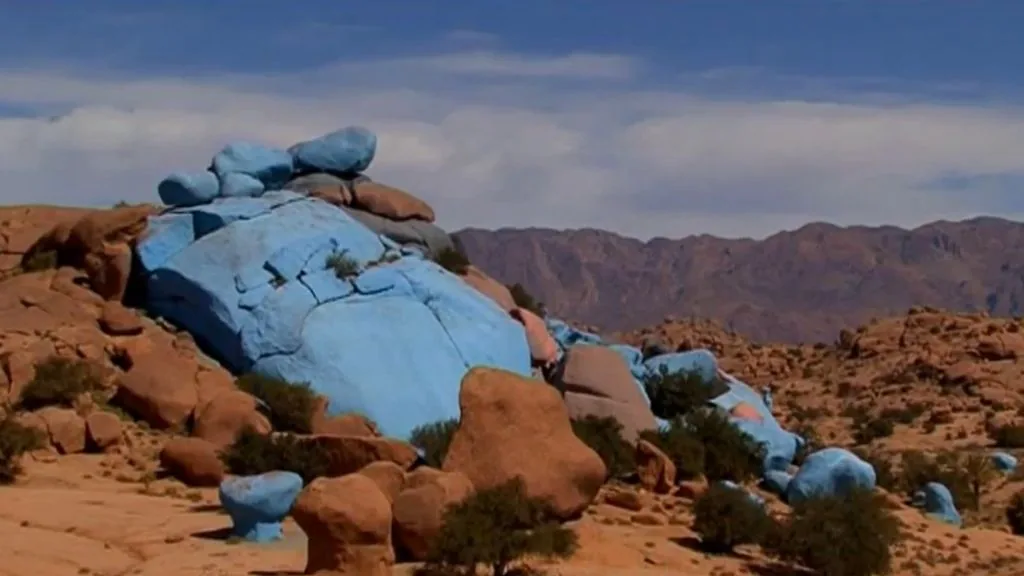
Tafraoute Granite Geology Explained
Tafraoute granite geology traces back to a molten intrusion that cooled deep underground during the late stages of the Pan-African orogeny, roughly 581 million years ago. Millions of years of uplift and erosion later stripped away the rock above it, exposing the pink granite domes and boulders that surround the town today.
A Molten Root Cools Beneath Ancient Africa
Long before Tafraoute existed as a town, this stretch of the western Anti-Atlas sat near the closing stages of a mountain-building event that geologists call the Pan-African orogeny. Continental fragments were colliding and welding together across what would eventually become northern Africa, and deep beneath the surface, pockets of molten rock rose through the crust and stalled before reaching daylight. One of these pockets solidified slowly, crystal by crystal, forming the granite body now known as the Kerdous inlier.
Slow cooling underground matters. It gives crystals time to grow large enough to see with the naked eye, which is why Tafraoute granite has that coarse, speckled texture rather than the fine grain of rock that cooled quickly at the surface. The magma that built these domes never erupted as lava. It hardened in place, a few kilometers down, and waited. Everything visible today, the boulders, the cracks, the rounded hills, is the record of what happened after that cooling: hundreds of millions of years of rock being pushed upward and slowly uncovered.
Wind and Water Carve the Domes of Agard Oudad
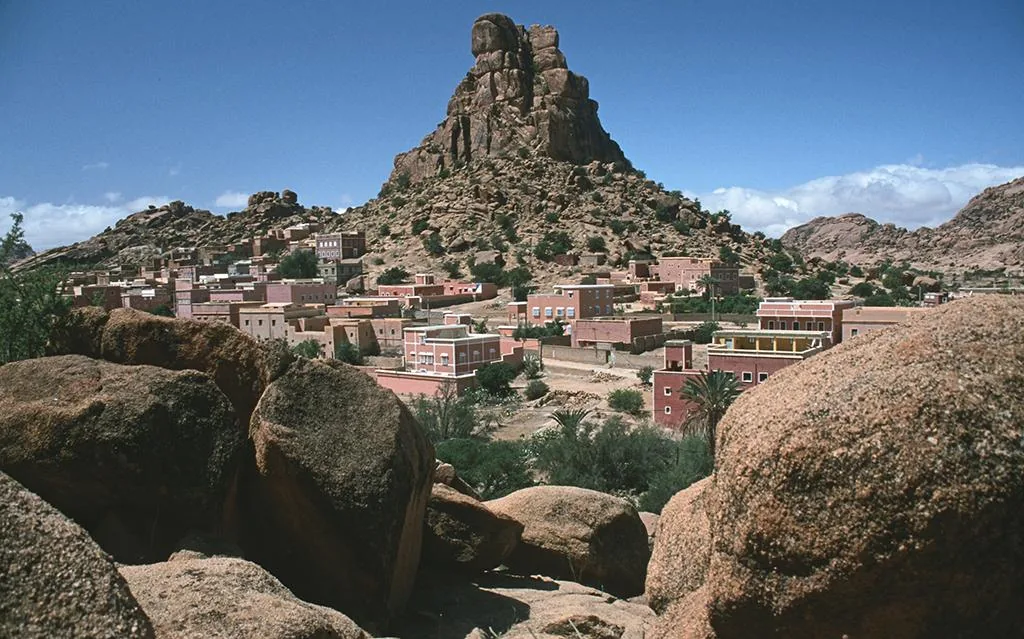
Granite that cools underground fractures into blocks as pressure releases on the way up, and water works into those fractures first. In the hills around Agard Oudad, just outside Tafraoute, this process rounded sharp-edged blocks into the smooth domes and balanced boulders that define the landscape. Geologists call it spheroidal weathering: corners erode faster than flat faces because they are exposed to moisture and temperature change from more directions at once, so a rectangular block slowly softens into something closer to an egg.
The most striking result of this process sits above the town itself. Locals call it the Napoleon’s Hat, a slab of harder rock balanced on a narrower granite base, shaped by differential erosion picking away at softer material below while the cap resisted. It looks improbable, like something placed there deliberately, but it is simply the leftover shape of rock that eroded unevenly over an enormous span of time.
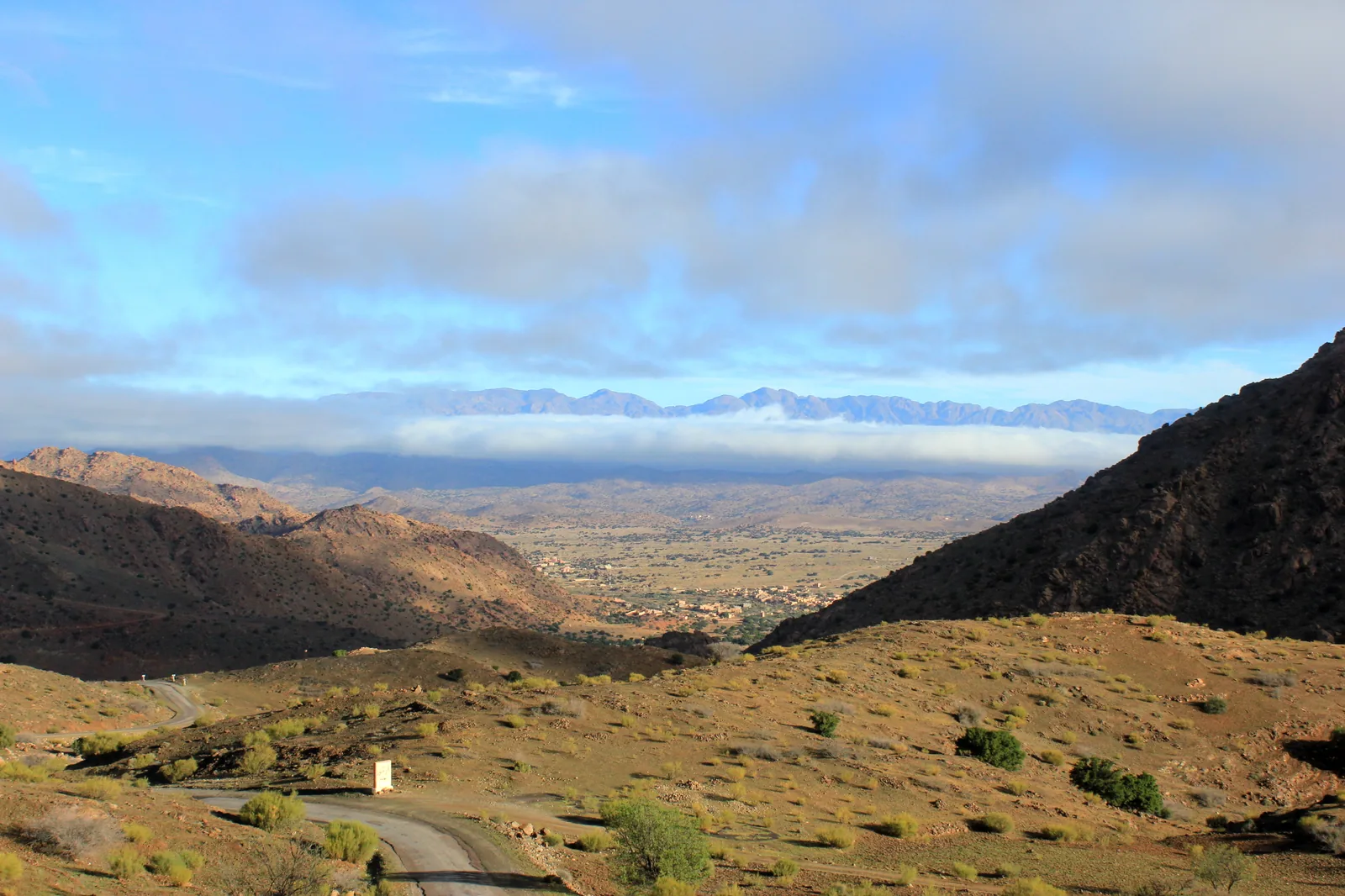
This same weathering pattern extends across the wider Ameln Valley, where twenty-seven Berber villages sit built into the base of an old erosional surface cut into this same Pan-African granite. The valley is not just scenery. It is a map of how slowly this rock has been coming apart.
What the Zircon Crystals Reveal
Dating granite this old means dating the tiny zircon crystals locked inside it. Zircon crystals form as magma cools and trap uranium atoms in their structure, atoms that decay into lead at a fixed, known rate. By measuring the ratio of uranium to lead in zircons pulled from the Tafraoute granite, researchers writing in the Journal of African Earth Sciences calculated a crystallization age of roughly 581 million years, placing the intrusion in the late Ediacaran period, among the youngest granites of the entire Pan-African episode in the Anti-Atlas.
That date matters for more than a number on a page. It places Tafraoute’s granite roughly eighty million years after the ophiolite rocks exposed further east at Bou Azzer, a slice of ancient ocean floor thrust onto the continent during an earlier phase of the same collision. Reading the Anti-Atlas from west to east is, in a rough sense, reading backward through the final act of a continent assembling itself.
Paint on a Half-Billion-Year Canvas
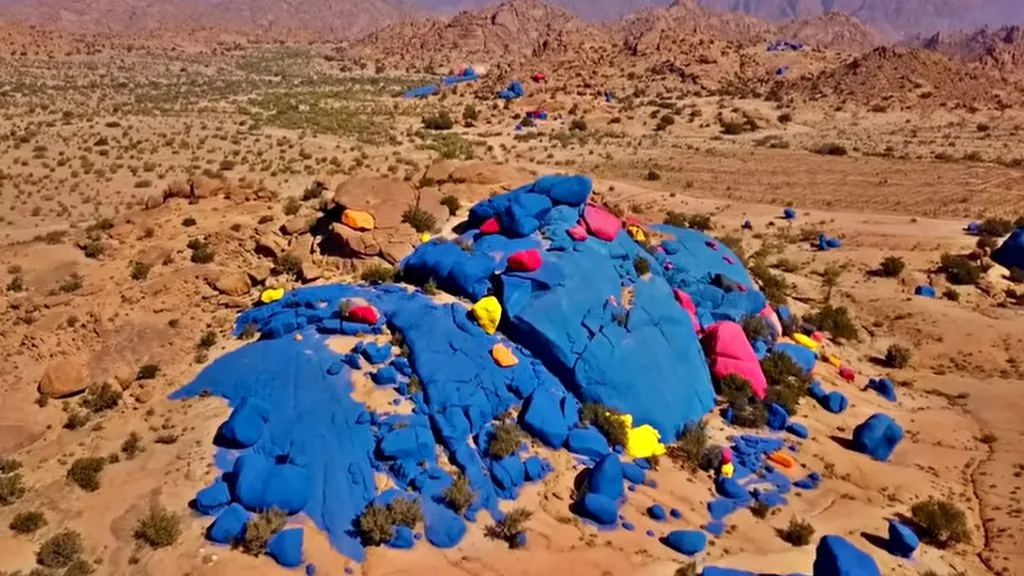
In 1984, the Belgian painter Jean Vérame arrived in Tafraoute with a plan that seemed almost absurd: cover a cluster of granite boulders in blue, yellow, and pink paint using eighteen tonnes of pigment and the help of the local fire department. The project took three months. Vérame never explained a deep meaning behind it, and locals still debate whether it improved the landscape or defaced it. Either way, it turned a piece of Tafraoute granite geology into one of the most photographed rock formations in Morocco.
The paint sits on rock that predates it by roughly 581 million years, a detail that gives the site a strange double life: modern land art resting on one of the last granite intrusions of the Pan-African orogeny, the same mountain-building event covered in the wider Anti-Atlas geology overview. Travelers who want to see this rock in a broader context, alongside mining country and mountain passes carrying the same deep history further east, can follow the full Anti-Atlas road trip itinerary.
Frequently Asked Questions
Why is the granite in Tafraoute pink?
The pink color comes from potassium feldspar crystals inside the granite, which pick up a reddish tint from trace iron oxide as the rock cools and weathers. The effect gets stronger at sunrise and sunset, when low light amplifies the warm tones in the mineral.
How old are the Painted Rocks themselves?
The paint dates to 1984, but the granite it covers is close to 581 million years old. The site combines one of the newest human interventions in the Anti-Atlas with one of its oldest exposed rock surfaces.
Is Tafraoute granite geology worth visiting for on its own, not just for the Painted Rocks?
Yes. The Ameln Valley and Agard Oudad domes show spheroidal weathering and granite landscapes at a scale rarely visible this clearly, and the wider region connects directly to Morocco’s Pan-African mountain-building history.
About the Author
Daniel Harper first stood in front of the Painted Rocks on a scouting trip through the western Anti-Atlas, more curious about the granite underneath than the paint on top. He returned twice more to walk the Ameln Valley at different times of day, watching how the light changed the color of rock that has barely changed at all in half a billion years.